I think it’s Thursday

I think it’s Thursday. I know it’s still November. But if my GP were to do one of those tests to assess my cognition right now, I’d have trouble with the year, and where I am, more specifically the international boundaries of our nation. Let me explain.

My routine is so shaken up, I wake up not knowing what day it is.

Each week of this lilac month has had not one but two important events, in not one but two important areas of my life, that I’ve played a big role in, if not outright organised.

At work we’ve had a short film competition culminating in an Award night, and a look back public talk, 50 years on, commemorating the 1975 Dismissal. In my theatre world, subtlenuance has just produced Atlantis by Paul Gilchrist at KXT on Broadway, to great acclaim.
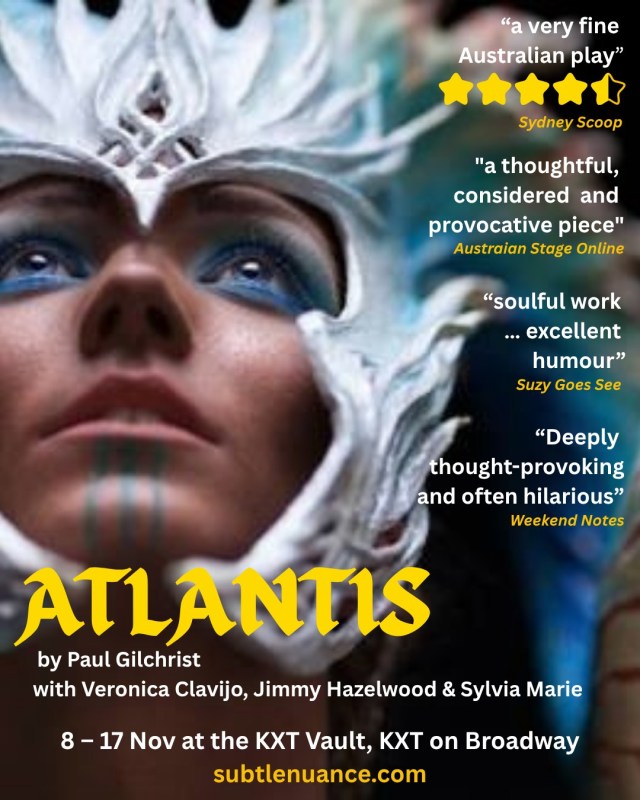
Broadway Sydney that is. You know that lively hub between Victoria Park and UTS. We put on the play in the Vault, a cool new space in a cool little indie theatre. Literally the basement of the old 1890s sandstone bank building the theatre is in. Our performance space was in front of the reinforced steel door that opens into a small room that holds the safe (behind a set of floor to ceiling iron bars) where the gold was kept. A vault. The production went off! And I even got to perform one night, standing in for an actor with a script. And now, we’re about to bump in our second production in the space, Stella, “A confronting comedy about being the centre of the universe” – you can buy tickets here.

The show starts just after I get back from New Zealand. Oh yes, I forgot to mention, I’m popping over to New Zealand for a few days.

Is it any wonder I don’t know what day it is?

But back to international boundaries. For some reason, all of this excitement has regressed my brain, not back to childhood as usually happens with memory loss, but back to circa 1899.

Although some days I do feel that my childhood happened in the 19th century.

Here’s an example. I was at work and hadn’t yet begun to prepare for my trip, which is a work trip, when my colleague said, “Be sure to pack a coat, it’s 16 degrees in Wellington”. This was on a 30-degree day in Sydney. So, I checked the BOM app on my phone. And then I said to my colleague, “Are you sure? This says it’s 32 degrees in Wellington.” And because I’d been stupid enough to say this out loud and in front of all my other colleagues, laughter erupted across the office and reverberated through the entire building, until one wag finally was able to choke out, “That’s Wellington NSW! You can’t look at New Zealand weather on the BOM! New Zealand is another country!”

Well. That’s easy to say now but as an ex-history teacher and a civic educator, I happen to know that in the 19th century, New Zealand was invited to join the Australian Federation, and participated in the early Federation conferences. Yes, they did decline the invitation just before all the other Australian colonies took the equivalent of marriage vows before any concept of divorce existed, but the Australian Constitution still includes a clause allowing for New Zealand’s future admission*.

I didn’t say any of that out loud to my colleagues of course. I simply retreated into an internal panic in which I had flashbacks to remembered fragments of other conversations I’d had recently. Like another colleague telling me to only pack liquids in 100ml bottles. And my partner gently suggesting that booking a taxi to get me to the airport only an hour before the flight wasn’t the best idea.

Now I get it!

It’s an INTERNATIONAL flight!

Suddenly, all of the hurdles I’d need to jump over the next few days rose before me. Would my phone work there? What about money? Would my card work there? Do they even have the internet? I mean, Peter Jackson did film Lord of the Rings in New Zealand. Yes, it was because of the stunning landscape but was it also because the country is authentically Middle Earth in other ways?

Do I need a Visa? I mean we’ve let a lot of New Zealanders into Australia over the years without one but do they feel the same way about us?

Luckily, I had renewed my passport recently. I do it as a matter of course even though, as you can tell from above, I haven’t actually left the country in at least 20 years. The last time, ironically was to New Zealand. But that was the South Island. And it was in the days before the internet and mobile phones. Or close to.
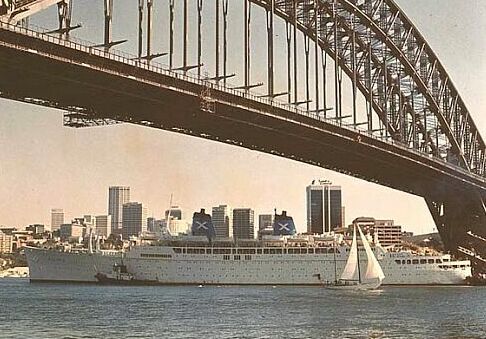
I renew my passport regularly because I wasn’t born in Australia. We came here on the S.S. Ellinis from Cape Town. My parents were economic migrants and I came with them when I was 7. They became citizens at Westfields Liverpool in 1978 – you can read about that crazy event here – and my name appears on the bit of paper they gave dad as an addendum to his citizenship. And because he’s been gone for quite a while now, and that bit of paper is rather old and frayed, and because I’ve kept up with how Australia treats some classes of non-citizens, the fear of random deportation to a country I don’t even remember has kept me turning up like clockwork, once a decade, at the passport office.

But now I’m all packed and I’ve ticked off all of the little boxes on my international travel checklist. And I’ve refreshed my understanding of what is and is not geographically part of Australia. After all, I don’t want to get into any conversational hot water with any proud citizens of New Zealand. I’ll be keeping that little tit bit about Section 21 of the Australian Constitution to myself.

And so, here’s to spending the last week of November in another time zone. I look forward to waking up not knowing what day of the week it is, or where I am, and actually having a good reason for it.


Notes and attributions: * Covering clause 6 of the Constitution states New Zealand may be admitted into Australia as a state. Section 121 provides the rules on how new states would be admitted. https://peo.gov.au/understand-our-parliament/your-questions-on-notice/questions/new-zealand-is-mentioned-in-the-australian-constitution-does-that-mean-that-new-zealanders-have-the-legal-authority-to-vote

Poster_australia_NZ_1788_1911_shepherd_1923 via Wiki Commons Media

National Archives of Australia, Public domain, via Wiki Commons Media

Lonely mountain by MaximKartashev – Own work, Public Domain via Wiki Commons Media

Posted in Theatre, Time, travel | Tagged , , , , , , , , , , , , , , , | Leave a comment

Sea Dog Summer

As the year turns towards winter, I find myself looking back to our sea dog summer spent at the southernmost point of the continent in the state of Victoria. There, on a stretch of coast between Lakes Entrance and Wilson’s Promontory, is Ninety Mile Beach – an isthmus that holds back the ocean. Behind it, a network of lakes cuts into the land like lacework.

Our destination for my partner’s big birthday holiday, and where we would see out the summer solstice, was The Honeysuckles on Ninety Mile Beach – a collection of shaggy beach houses about 5km east of the tiny town of Sea Spray. Although only last December, those golden weeks spent climbing the sandhills across from our house to walk the long unpatrolled beach, and dipping warily in and out of the water, have already become a sand-tinged memory.

For a real swim we’d head to Sea Spray where, although it was still too early in the season for the beach to be patrolled, we at least shared it with a few other lucky souls. This obviously satisfied our flocking instincts even if it did nothing to outsmart any predators that might have been lurking beneath the waves. (And not just beneath the waves. In my whole life, I have never seen a shark that wasn’t in an aquarium or on film until this summer and this holiday when we spotted not one, but two, cruising black fins along this very beach, but that’s a whole other story.)

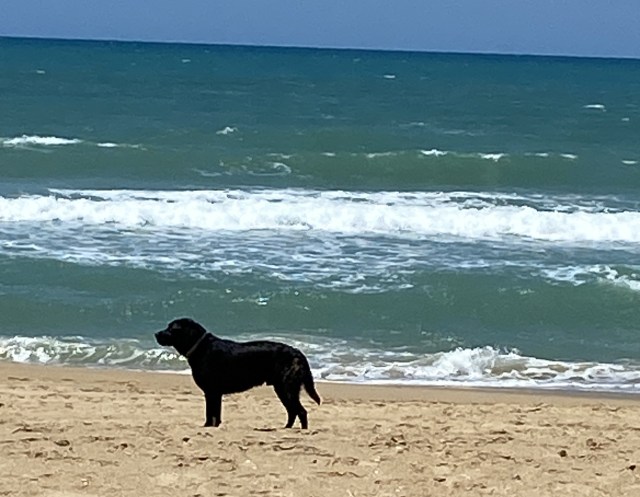
So I spent much of my time here sitting on the yellow sand staring out at the turquoise sea. That’s how I made a new summer friend. But even after he introduced himself, he never revealed his name, so for the sake of this story I’ll call him Sea Dog. I’d been watching Sea Dog have the time of his life: chasing sticks into the surf, swimming out beyond the breaking waves, then deftly turning and catching the swell to body surf back to shore. It was a performance worthy of the World Surf League. This dog committed to waves a lot of adults would baulk at. He would then drop the stick at the feet of the human that I’d assumed was one of his family and run back into the water in anticipation of the next throw. Then the whole action would repeat again. And again. And again. He never tired, never faltered in his quest; leaping each time without hesitation into the ocean, swimming out to the stick, his head going under as the rough incoming surf rumbled him, but each time coming back up for air. Then with the stick firmly in his jaws, he’d begin to paddle until he caught a wave. He showed no fear at all of the ocean or its wild inhabitants.

I was amazed at his fealty for the game and at the patience of the stick thrower, surely evidence of the bond developed over millennia in this ancient relationship between humans and canines. But now, the game had come to an end and the human had gone back to his pack who were gathering their belongings in order to leave the beach. I was intrigued when Sea Dog didn’t immediately join them. I’ve witnessed many a dog refuse to go home after an outing. Usually, the leash has to come out and be clipped on. That’s when the dog plants his bottom and his front paws firmly onto the ground and the human is forced to either drag or carry the animal home. What surprised me now was that the leash never made an appearance and the family left the beach without even once looking back. Sea Dog stood nobly on the sand ignoring the desertion.

So, maybe he wasn’t their dog? But looking around I realised there wasn’t anyone else on the beach now. It was nearing lunch time and it seemed that everyone except us had returned to their hearths to satisfy their hunger. My partner continued to play blissfully in the shallow waves, somewhat resembling the labrador I must say, and I was contemplating joining him when Sea Dog walked my way. I said hello. In reply he turned himself to face the water and sat on my foot. I patted his salty black fur as he lovingly dripped saliva all over my beach towel. Of all the feet on all the beaches in the world, Sea Dog had sat on mine. This was going to be the beginning of a beautiful friendship.

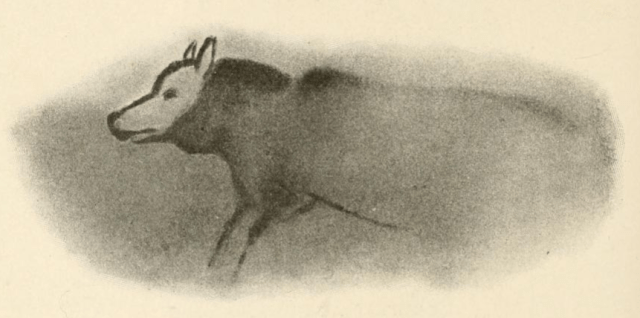
Perhaps we were even mirroring the start of the loyal relationship between our two species. Picture this: a Neolith is daydreaming beside her campfire when a Canis lupus approaches and sits on her foot. From thereon in, (wo)man and wolf are inseparable. I’m shaken out of my reverie by the more likely picture of the wolf running into the fire circle to snatch whatever was on the grill while the human was distracted by their jar of fermented berries.

As I basked in the warmth of this new found relationship, and the December sun, I watched my partner emerge from the water and walk up the sand until he was standing next to us. I was about to introduce him to Sea Dog but sensed a sudden tension in my new friend; a subtle shift on my foot. That’s when Sea Dog turned to look at me accusingly, as if to ask, “Who the hell is this guy?” Without waiting for my response, he pushed himself up, shook the remaining sand off himself and walked calmly away. Just like that. Not looking back even once.

What had just happened here? I’d been with my partner for over thirty years, and this dog had been with me for all of three minutes, and suddenly it was ‘my way or the highway’? That’s when it dawned on me that the whole relationship had been conducted on his terms, not once in the whole interaction had he done anything but sit around as if he owned the place.

Reeling from the realisation, I watched as he strolled over to a little family that had just arrived on the beach. The children had run to the edge of the surf and the father was setting up their cabana. Mum was sitting on a towel unpacking a picnic basket. Sea Dog flopped down on mum’s foot and turned to look out at the ocean. It was as if our relationship had never happened. This dog was like a furry re-incarnation of the Fonz. He was a rebel without a cause. He was Casablanca cool. He was everyone’s dog and no one’s dog, happy to leave a wave of broken hearts in his wake. Well, he probably was someone’s dog, particularly when it came to dinner time. I imagined there was some old lady somewhere waiting for him to return at twilight, filling his bowl and asking about his day.

Now, firmly entrenched back in my city life, the summer holidays long gone and winter on the approach, I think back to that brief friendship and wonder what my temporary canine companion is doing now that the summer visitors have long left the beach. Who does he befriend in winter as the sharp winds tear in from the South? Does he hang out at the Bowlo? Tee off with the blokes at the golf course on a Friday afternoon? Perhaps mow people’s lawns in exchange for a cuddle? And in the evenings, whilst tucked indoors with his wrangler by a roaring fire, does he ever dream of his lost summer friend?

And when she falls asleep, does he silently leave the house, meandering out onto the    star-sewn night beach, possibly with a little barrel of apology attached to his collar, in search of his friend from this summer past? Does he sit on the cold sand gazing out above the inky ocean into the vastness of the Milky Way and regret so easily walking away? I guess I’ll never know what he’s up to now but we’ll always have Sea Spray. Here’s looking at you Sea Dog.

(Wolf drawing by Henri Breuil, and starry night sky, courtesy of Wikimedia Commons.)

Posted in The Animal Kingdom, travel | Tagged , , , , , , , , , | 4 Comments

A Weekend of Unexpected Gifts

I’m woken by the sound of a church bell. I know it’s not a work day, so it’s not my alarm. And it’s not the joyful jangle of sound that rings out from the nearby Greek Orthodox Cathedral on a Sunday morning. Although it sounds like it’s coming from the same church. This is the long slow peal of a single bell, ringing out over and over again after each brief interval of silence. I’ve never heard a death knell before but this sounds like one. Then I remember it’s Good Friday. The sound continues intermittently all day and now into evening as I sit in my lounge room reading.

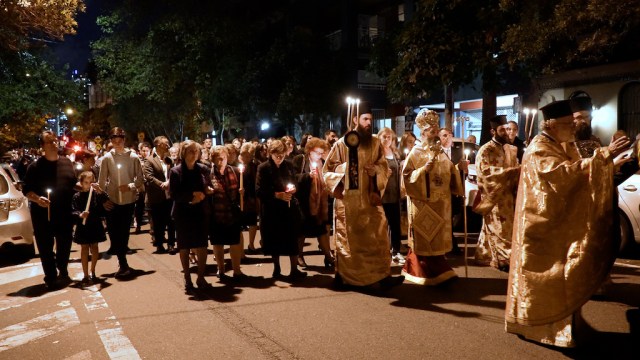
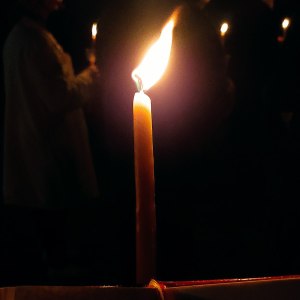
Through the open window I hear the shuffle and murmur of a crowd, followed by the sonorous timbre of a male voice chanting what sounds like a funeral hymn. I get up to have a look and stepping out onto the balcony I’m surprised by a slow wave of lit candles moving through the dark laneway behind our building. It’s an astonishing and ethereal sight. As the tail of the crowd passes our gates and the candles disappear, I decide to follow them.

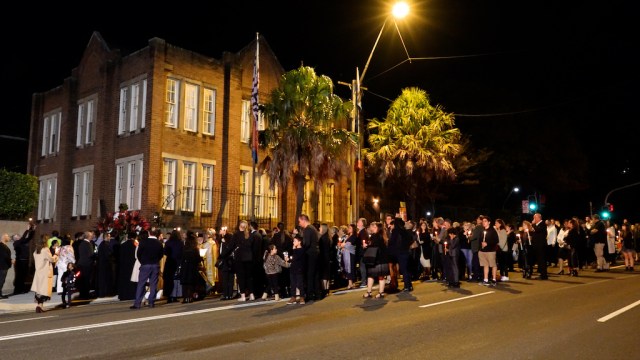
Out in the lane, the flashing lights of a police car greet me. The road ahead is closed to traffic. I catch up with the procession and walk slowly behind them. We move at pace with the still tolling bell. There are parents and children, teenage girls all dressed up, and a few older people, talking and laughing as they walk. Outside one terrace house, a family four generations deep stands with candles, watching the procession go by. As it passes them, they step out of their gate and join in.

A middle-aged man, out walking his old Jack Russel, has stopped to chat with someone in the front yard of one of the new apartments.  As I walk by, I hear him say, “The Greek Church. They do it every year.”

“Really? That’s cool,” the younger man inside the front yard responds. And it is. On this long weekend Friday night, this procession has added a dose of enchantment to our neighbourhood.

The front of the crowd reaches Cleveland Street where the police have stopped traffic, and snakes left, back towards the cathedral. I decide to cut through along James Street which runs in parallel. Suddenly I’m in a dark laneway all by myself. I start jogging, running past the Reconciliation Park Community Garden, and turn right onto George Street, finding myself thankfully once again at the edge of a crowd. I stand with the police officers and other locals, observing as a row of giggling young altar boys in white robes walk by. They head the procession, followed by eight men wearing black suits, looking like pall bearers, carrying a decorated wooden temple. It’s the Epitaphios, which apparently bears an image of the dead body of Christ. I realise I have been following the re-enactment of a funeral service for a long dead god.

Two priests in long black robes follow, each swinging a metal incense burner on a triangular chain. The scent of frankincense wafts across the street. The whole procession stops in front of the gates of the cathedral and a prayer is chanted as they move in. As the last of the faithful disappear a sudden quiet descends on the now empty street; a mystical transformation of this usually noisy, grid locked road. It’s almost enough to tempt me to believe in this story of miracles and redemption.

The crowd disperses and I  walk slowly home along the terrace lined street and my glimpse into other lives and their stories continues. At the last of the houses, I look into an open doorway and my eye is led along a lit corridor to a kitchen where a man prepares a meal. A little further along, walking past a block of flats, I look through a window into a lounge where a woman sits in front of a television screen. Ahead of me, on the crest of the ridge, the Post Office clock tower, topped with a green cupola balanced on Italianate arches, is brightly lit against the deep indigo of the night sky. It stands watching over our high street like a medieval Florentine tower over that small city state.

Back home, I make a tomato and cheese sandwich for dinner. Afterwards, as I put the kettle on, I hear the sound of a honky tonk blues piano. It sounds like someone riffing. They are joined by a trumpet and it’s as if a cart load of boogie-woogie gypsies has just arrived in our suburb. I stand listening as the sound threads its way down the street and I realise it’s coming from someone’s portable Bluetooth speaker. I imagine the past and its stories following the sound down the high street like a troupe of ghosts mimicking the Good Friday procession or perhaps something closer to November’s Night of the Dead. I see the present, with its wild juxtapositions of wealth and poverty, sanity and madness, elation and sadness, country town quiet and the siren sounds of the city, standing on the sidewalk to watch the passing parade.

A little later on in this long weekend, midnight on the Saturday to be precise, I’m woken once more by bells. They’re coming from the same church but this time they’re a wild joyful jangle of sound. As the bells continue to ring, I doze in a semi-dream state, imagining that I’m flying above the cathedral. It’s lit from within by hundreds of candles as the hymns of the gathered congregation spill out into the night, transforming this period of mourning into a time for celebration. The bells finally stop and my mind flies back to my darkened room, my breath sets its rhythmic course towards morning, and I return to sleep, lulled by the weekend’s unexpected gifts.

Images: Courtesy of Wikimedia Commons including ‘The Epitaph at the Good Friday service at St. George Orthodox Church in Adelaide, Australia’ by Maggas and ‘Lit Candle on Easter Sunday Rite’ by Cyan Star
Posted in Spirit of Place | Tagged , , , , , , , , , , , , | 1 Comment

Lost Churches, Chocolate Coloured Horses and an Absinthe Couch

I’ve been trekking through Waterloo and Redfern hunting for lost churches. Two of them. To paraphrase Oscar Wilde, “To lose one church may be regarded as misfortune; to lose both looks like carelessness.” Luckily, I think I’ve found them. Or at least where they used to be. (But beware, family photos have been used in this post and they include loved ones that have passed on.)

Although I’m not devout, I think churches are fascinating archives of time and place. And I do love to find an open church and sit for an empty moment. It feels like an escape from the binds of time. As urban moderns, it’s tempting to throw out the baby of spirituality with the bathwater of religion but I’ve decided to keep what I like and let the rest go. I guess my early church experience, in particular receiving the sacrament of baptism, turned me into a non-practicing cafeteria Catholic.

But back to looking for lost churches. As I stood on the corner of Redfern Street and Walker Streets, the former site of the first Antiochian Church in Sydney built by Syrian and Lebanese Orthodox Christian migrants in 1920, I witnessed a strange encounter.

A man pushing a shopping trolley along the road came to a stop at the intersection. He  paused to check for traffic. Balanced precariously on the top of the trolley was an old two-seater couch in an unusual shade of green velvet, possibly absinthe. Although Redfern is the kind of place where you will often see strange items transported on bicycles or trolleys, I’ve never seen such a large or colourful piece of household furniture moved in this way. To properly quote Oscar Wilde, “I can believe anything, provided it is incredible.”

The man craned his neck around the side of the couch to see if it was safe to cross. That’s when I heard him say to himself, “Oh, here we go.” Looking in the same direction as he was, I saw two mounted police officers, walking their chocolate brown horses slowly up the hill to where we were standing.

The expression on the man’s face brought to mind Jesus in the garden of Gethsemane. As the officers passed us, one of them called out, “How ya doing?” like they knew the man and often crossed paths like this. Perhaps they did. He tipped his hat to them, literally, he was wearing an old dark green baseball cap. As her horse paced steadily past me, the policewoman looked down and smiled. I felt like a character in a bucolic 19th century novel. As the horses continued their slow clip clop down the other side of the hill, the man crossed the road with his load and continued on his way. The lesson for me: I don’t actually need to be sitting in a church to experience the mysteries of the universe.

So I turned back to the simpler contemplation of changes in the landscape. The archives are silent on what the church that used to stand on this corner looked like. I did discover that it was built on land leased from the NSW Government. In 1950 the lease ended and the church was demolished, replaced by three-storey red brick public housing flats. In 1953 the community built a new church – the St George Antiochian Orthodox Cathedral – about a hundred metres away on the corner of Cooper and Walker Streets.

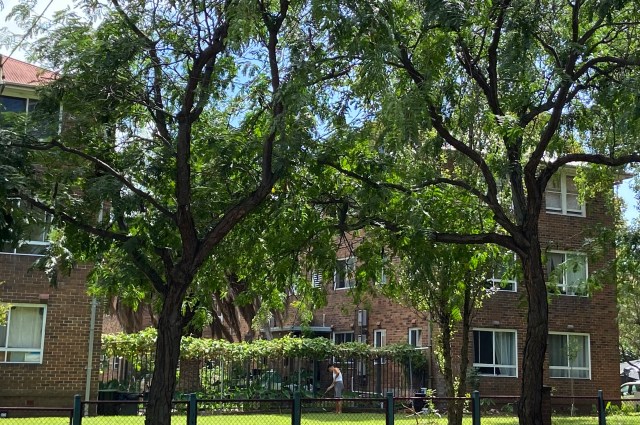
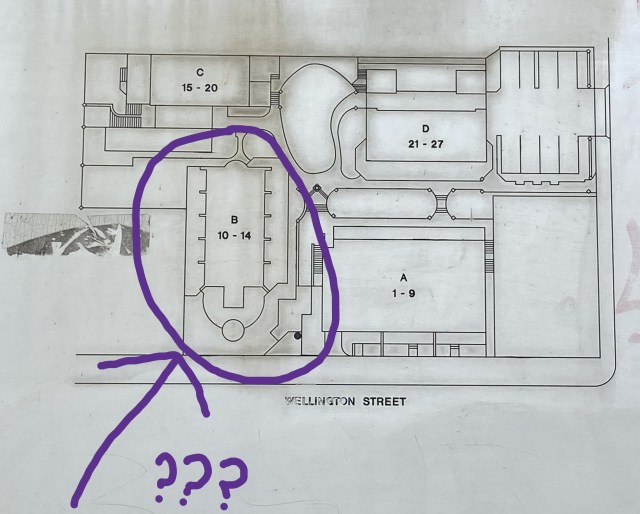
The other lost church is St Michael the Archangel Melkite Church which used to stand on Wellington Street in nearby Waterloo. Walking past previously, I’d noticed the 1970s housing estate block whose entrance distinctly mimics, in brick, the sandstone arched doorway of a gothic style church. Next to it is a graffitied wall in faded salmon with a map of what looks like the floor plan of an early Christian Basilica.

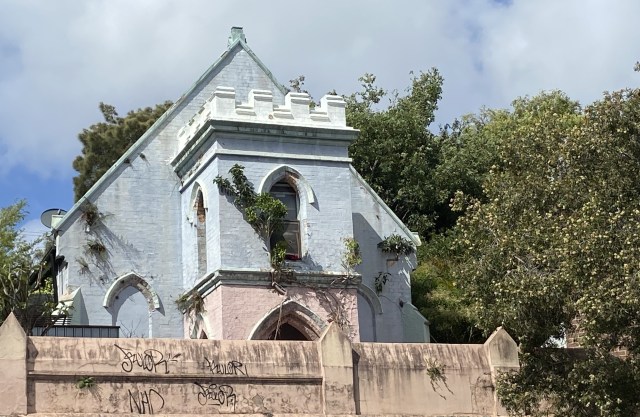
But walking past this morning, I noticed that the salmon camouflaged an arched entrance, now blocked off but still sign posted by Boston ferns and other wild greenery that grow from the line of plaster that outlines the old arch. Above this, the top of the wall mimics the ramparts of a castle and behind it is a faded pink and baby blue turret, with its own arches. From across the street, you can clearly see the classic pitched roof and Saxon style tower. The plot had suddenly thickened. Could this old wall be hiding a secret church?

So, I detoured into the nearby library ready to do some good old detective work on the history of Waterloo. Unsurprisingly, I read that the suburb’s heyday was over a century ago. Then, thanks to an article by Jack Bettar for the Australian Lebanese Historical Society, and the friendly librarian, I discovered that there had indeed been a church behind the mysterious wall. It was built by migrants from Syria, Lebanon, Egypt and Sudan circa 1895 but the site was sold to the NSW Housing Commission in the late 1970s. The congregation moved to nearby Darlington and the church was replaced by housing estate flats. There was definitely a demographic pattern happening here. But there was also more unsolved mystery. The image of the church that I’d found in the library was very similar but also very different to the remains of the site now.

I was determined to solve this conundrum and after careful examination of dates, I realised that there was a plausible explanation for this archaeological discrepancey. The older photo was taken in 1939 and reflects renovations that were made to the church site in the early 20th century.  Now I felt like a proper sleuth.

It was as I read more about the history of Lebanese migrants in Sydney that I discovered the other vanished church in my neighbourhood. Determined to find it, I’d made my way to the intersection where I witnessed the encounter between the police and the absinthe couch man, as I’ve decided to call him.

These lost churches should not have taken me by surprise because my local area is thick with places of worship. These include the Annunciation of our Lady, Greek Orthodox Cathedral; St Maroun’s Maronite Cathedral; four Catholic churches – St Vincent de Paul, Our Lady of Mt Carmel, St Peter’s and St Benedict’s; the Indonesian Christian Church,  GKY Sydney; the Sydney Maori Arohanui Fellowship of Te Wairua Tapu; the Hill Song Church and One1Seven Church. There are also the Redfern Mosque, the Quaker Religious Society of Friends Meeting Place, and the NSW Evergreen Taoist Church.

Interestingly, most of these places are located in the hills of east Redfern. This shouldn’t surprise me either because historically churches were often built on higher ground and in Sydney they were some of the earliest land grants to be made. In the 19th century, Surry Hills and Redfern had a large Irish Catholic community and a larger protestant population. The churches in this neighbourhood map the waves of immigration that have flowed through the city after the tragic dispersal of the original inhabitants. New migrant communities often took over the buildings of churches no longer used by earlier denominations who had moved on from the area. These places hark back to a time when religion was not only a main marker of identity but an important social connector in a new land.

Let me segway for a moment into some personal history to evidence this point. My parents were Italian migrants and although neither of them were overtly religious, they married and christened their children in a church in Johannesburg. They also turned up for weekly mass. But I suspect it was Sunday lunch with all the other ex-pats, following the service, that drew them back regularly. After arriving in Australia, my family’s attendance at church was reserved for special occassions: Easter, Christmas, weddings, funerals. Most weeks, Sunday church services were replaced with Sunday lunch at the Italian club. And so, as a teenager, after completing the ritual of First Holy Communion, I was left free to roam in the garden of spirituality and occasionally out onto the footpath of agnosticism, with the rare foray onto the wide road of atheism.

After the morning’s exertions I was happy to leave the past and its churches behind and decided to pop into one of my favourite coffee shops, the aptly named St Jude’s. But first I had to find it. It’s one of those places that has a mysterious habit of disappearing – it never seems to be on the street I think it’s on and so I’ll walk around and around in ever narrowing street blocks, getting hotter and hotter, and hungrier and hungrier, as I try to locate it. I tell you; it’s easier to find a lost church than it is to find a vanishing cafe. But, glass half full and all that, it’s always great exercise and when I finally did stumble upon it, I indulged, guilt free, in one of their delicious freshly baked muffins.

The cafe is on Bourke Street, just a few doors down from the home of the chocolate coloured horses, so as I sipped my coffee, I thought back to the man with the absinthe couch, and wondered what Oscar Wilde would have had to say. Perhaps: “to encounter one chocolate coloured police horse may be regarded as misfortune; to encounter two looks like carelessness.”


Image attribution: St Michael’s Melkite Church, 1930s courtesy Jack Bettar, Australian Lebanese Historical Society; Police horses Redfern, courtesy NSW Mounted Police; Annunciation of our Lady Greek Orthodox Cathedral interior courtesy City of Sydney Archives.
Posted in Habitat, Spirit of Place, Time, walking | Tagged , , , , , , , , , , , , , , , , , | 2 Comments

The Poetry and Promise of Architecture

Or Flaneuring in Foyers.

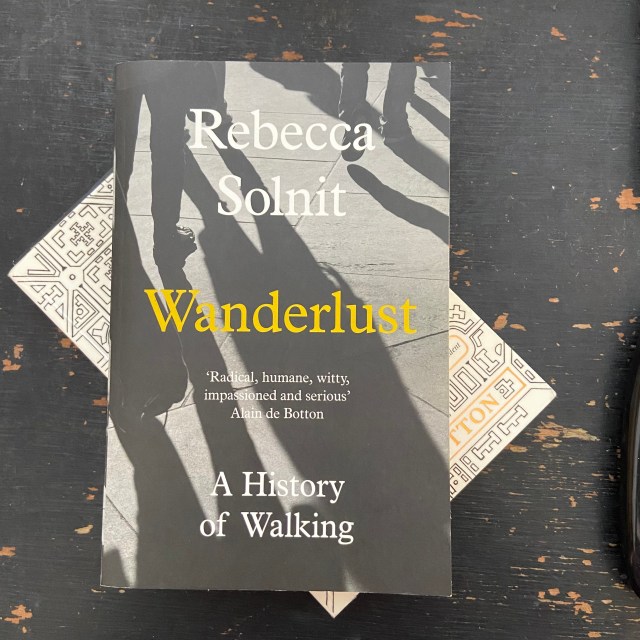
In a recent article for The Guardian, Rebecca Solnit writes about resistance, something that is more important than ever in these terrifying times but in one of my favourite of her books, Wanderlust, she also writes about flaneuring. Flaneurs have been described as ‘loiterers’, ‘fritterers’and ‘primeval slackers’ and, to paraphrase both Solnit and Baudelaire who she quotes, asphalt botanisers who find enchantment in the streets. All of them though have in common a curiosity about ‘the city as some kind of wilderness, mysterious, dark, dangerous and endlessly interesting.’

Although I encountered no danger or darkness whilst flaneuring in the foyers that I discovered whilst on a recent jaunt into town, there was plenty of enchantment, and much fodder for a philosophy of resistance.

One of my favourite things to do whilst traipsing a city street is to take a twilrl through a set of revolving glass doors and, after several attempts at exiting into the foyer and not back onto the street, find myself in one of these purely functional spaces that are surprisingly often quite beautiful.

But before we meander into our first foyer, lets scrutinize the etymology of this word (fact checking being as essential to the resistance project as a lifejacket is on a boat.) There seems to be a little disagreement about what we should call these part public, part private, in-between spaces. According to Wiki, a foyer is the ‘intermediate area between the exterior and interior of a building, especially a theatre. The name is also applied rather indiscriminately to lobbies of public buildings.’

Okay, so perhaps I wasn’t flaneuring in foyers but simply loitering in lobbies.

In the spirit of resistance, I continued to google. According to Squeegee Squad, experts in the design of building lobbies, a lobby is ‘the first thing people see when entering a building. It may also be referred to as a foyer or entryway.’ Phew.

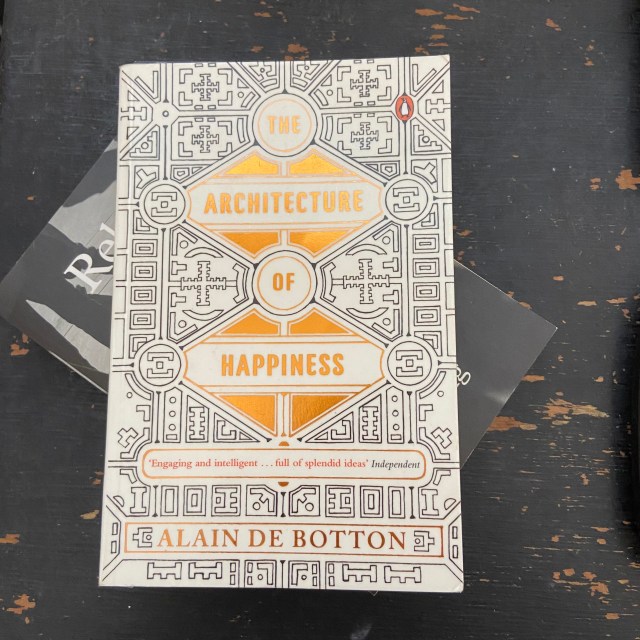
But then I decided I should consult more than Wiki for my information because the internet is making us both dumber and smarter at the same time. So, I borrowed an excellent book from the library, The Architecture of Happiness by Alain De Botton. Now I felt confident that when asking difficult questions about foyers, I would get appropriately complex answers not just an AI deep sea trawl of a billion websites. After all, simplicity is the enemy of democracy and the whole point of resistance is to protect that frangible concept.

Although Botton didn’t spend anytime defining foyers in his 270 page tome, he was nonetheless helpful, reminding me that buildings speak to us of what we think is important, they ‘prompt a state of the soul’. And so, I will try to explain what these three foyers within a kilometre of each other in Sydney’s CBD, said to me.

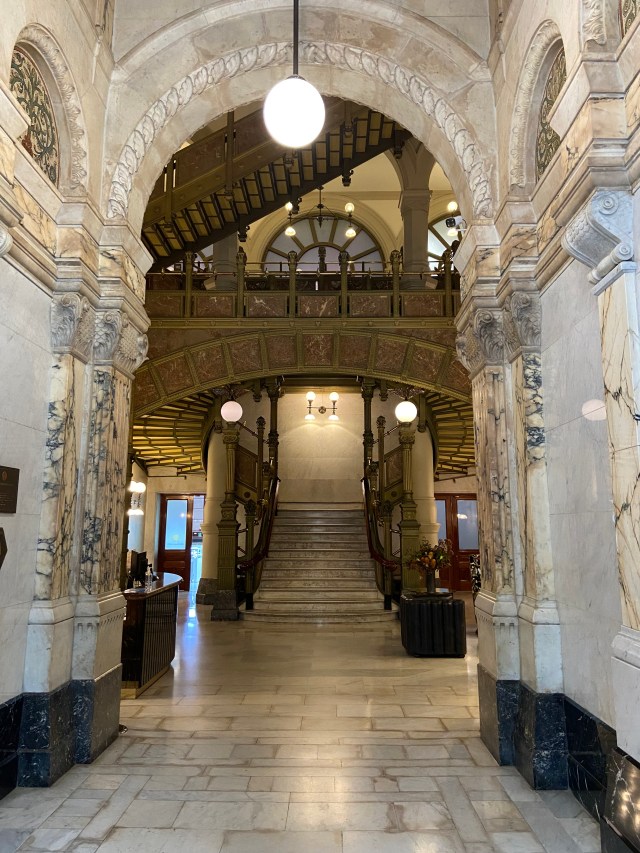
The first foyer was at 350 George Street, abutting Angel Place, one of those grand Romanesque granite buildings that makes this end of Sydney’s premier boulevarde, with its nouveau wall of high-end boutiques, feel like 5th Avenue. It was designed by American architect Edward Raht and constructed in the early 1890’s. Although it’s been around for a lot longer, I have ignored this building my whole life and only happened on its foyer on this day because I wanted to avoid someone’s footpath coughing fit (yes, a Barnacle like remnant of COVID paranoia).

Who knew there was such splendour behind the boring old stone façade? All marble and gilded wooden bannisters ascending operatic staircases. It’s the ultimate in Baroque Revival. I imagine it was built to reflect the wealth and excitement that would have flowed through the streets of Sydney at the very end of the nineteenth century and just before the Australian colonies federated into a squeaky new nation. Women didn’t yet have the vote in 1895 when it was built but one of the building’s tenants, suffragist Maybanke Wolstenholme, ran her newspapers, Woman’s Voice and Women’s Federation League from offices in the building. Her and her sister suffragettes’ acts of small and large resistance over several decades resulted in Australian women winning the vote in 1902. I imagine Maybanke turning up each day (persistence being essential to democratic progress) and being inspired to continue by this courageous fake it till you make it foyer.


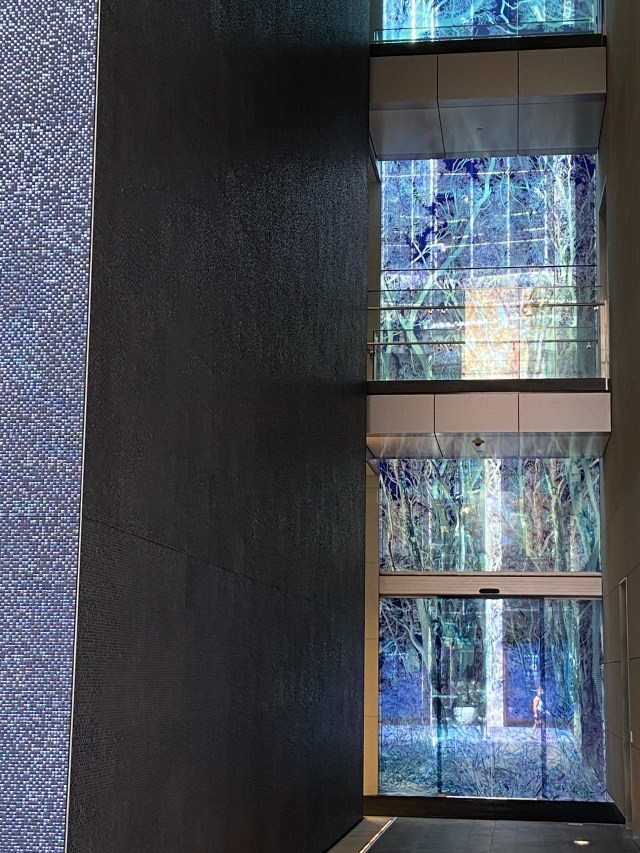
Barangaroo is a new place to hang in an old city. It faces west so requires courage to visit on a summer afternoon but is a shady waterside destination in the mornings. I can recommend the coffee in the foyer of Number 3, International Towers at Exchange Place which was completed in 2016 and designed by Richard Rogers and Ivan Harbour. Kinda cute considering the building is on the eastren edge of Darling Harbour.

I’m a big fan of the important trend of foyers with their very own coffee shop. Although this foyer takes care of the quotidian needs of its inhabitants, it also speaks of the opulent aspirations of the 21st century. Sky soaring walls the deep blue of a glittering ocean and chandeliers that drop from unfathomable heights suggest wealth with a sleek contemporary tone. Built to reflect the virtues of order and balance and to inspire human endeavour through beauty, it’s a wonderful welcome for your work force.

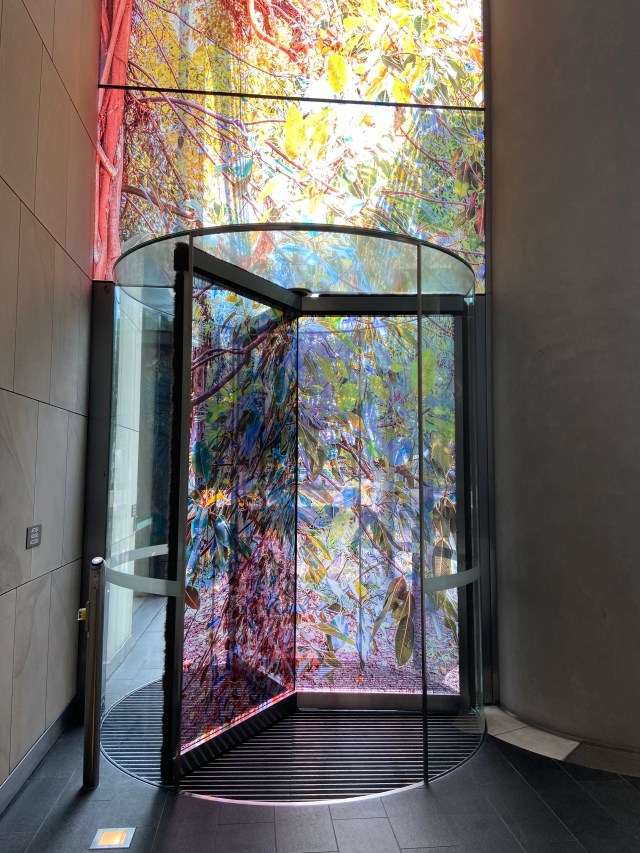
And then there are the panels over the entrances that evoke the Australian bush at sunrise and sunset, harking back to medieval stained-glass windows. And reminding us that each day is a new start but will also finally end. A perfect accompaniment for the 9 to 5 rhythm of an office building.

But those panels are subversive too: hinting at, reminding us, admonishing even, with visions of what (and who) was here before the skyscraper city that superseded the original landscape. I cannot imagine such a message being allowed in a building in Hitler’s Germany for example – there the purpose of design was to speak always of impregnable power. Only in a democracy can the soft underbelly of our society be revealed in the everyday of architecture.

On the weekday morning in mid-January that I stepped into this foyer it was filled with crisp suits and pretty office dresses which easily matched the beauty of the space. I was carrying out my own small acts of resistance by not wearing either of these uniforms, and feeling fine about not spending my day toiling in the heights of this great tower. But I was not going to resist the nutty caramel smell coming out of the coffee machine.
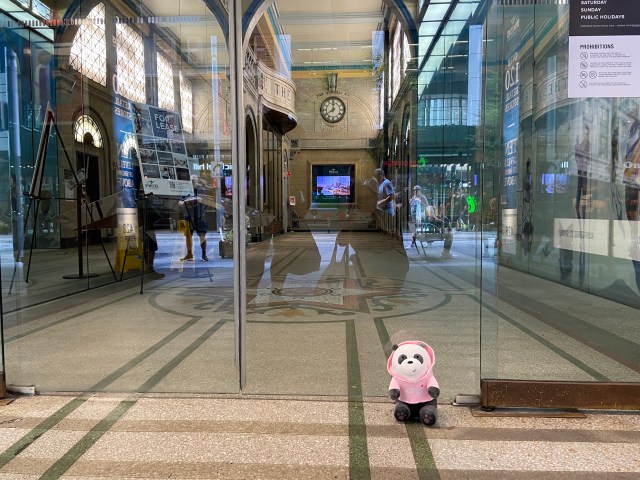
As I waited in line for what turned out to be very good coffee, the mood was reminiscent of the first day back at school after a long summer break. Before social media that is, when the only people you’d spoken to for six weeks were your family. No doubt the energy in this foyer varies with the seasons.  So, it’s a perfect place to nip out to when the office drama just all gets too much.

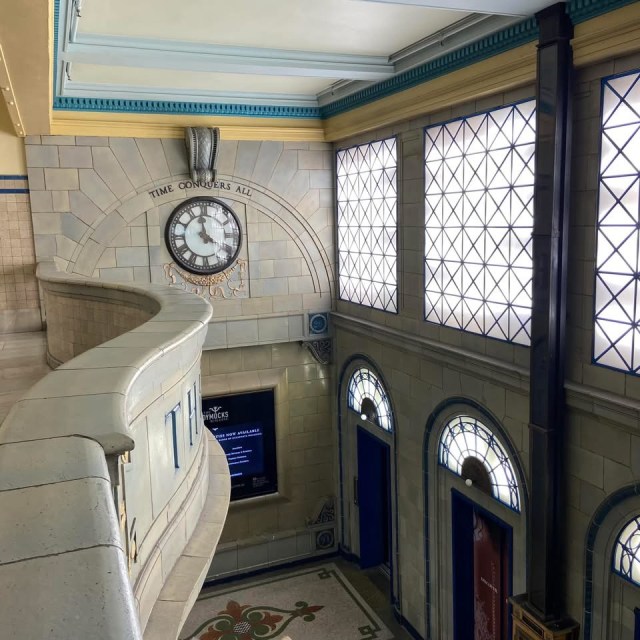
A little while later and back on George Street, I popped into one of my favourite city foyers in the Dymock’s building. This is a platform nine and three quarters sort of foyer whose decorative symmetry in the 1920s Commercial Palazzo Style is an adventure in its own right – but it’s also the portal to nine galleries – whole floors of exquisite little shops (including beauticians, dressmakers, goldsmiths and purveyors of vinyl records, devotional goods and fishing equipment). The whole shebang was designed by architect F. H. B. Wilton. It’s further testament to the failings of the internet that I cannot discover anywhere online Mr Wilton’s given names. But then a bad carpenter always blames her tools. After all, for most of my life I didn’t know this place was even here but that doesn’t mean it didn’t exist.

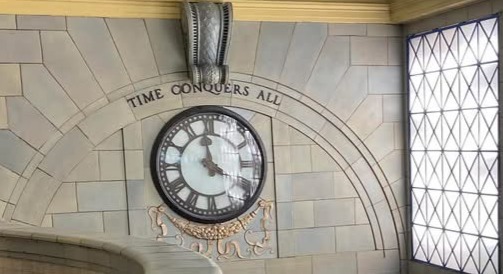
I now regularly drop into this foyer, usually after reading the morning news, and not because there is a coffee shop – it’s in the second-floor loft of the adjacent Dymock’s Bookstore and is also highly recommended – but because I need to re-read the inscription above the Roman numeral clock that hangs wisely in the foyer.

For modern flaneurs, foyers are perfect for accidental expeditions neatly fitted in between acts of resistance. In fact, one might say this sort of subversive time wasting is itself a form of resistance, especially if you add in animal plushies, emulating the tactics of those 20th century Eastern European activists who strategically placed stuffed toys in public places as a protest against the draining dourness of totalitarianism.

Foyers are a combination of tiny art gallery (the poetry of architecture) and weird escape room (the promise of architecture). However, when the flaneur leaves the foyer, the bright light of reality awaits. Luckily, the great foyers are within salivating distance of an excellent coffee shop (I argue that this is intrinsic to its greatness as a foyer) complete with scrumptious cake selection. I’ll have to hop onto Wiki to amend their definition of the word foyer to include this important element.

Returning to idea of cultivating a philosophy of resistance: in her article, Solnit suggests that fighting for justice doesn’t have to be a big dramatic act. It can be small. And it can be accompanied by cake. This bit was not suggested in Solnit’s article but then she’s a little closer to the action at the moment where levity is harder to emote. From the safer distance of the Antipodes, I will suggest that amongst our acts of resistance we should include eating cake but also paying attention; being silly but also asking difficult questions; encouraging complexity but also delighting in simplicity. Walking, talking, joining, dissenting, subverting and let’s not forget laughing. After all, the popular 19th century tradition of duelling to restore one’s honour was laughed out of fashion by a new generation that thought it the most ridiculous way to resolve a dispute.

So, the next time you pass an unknown foyer, step into the wilderness and enjoy the mystery, taking a moment to resist autocracy and regroup in the endless fight against oppression.

Posted in democracy, Spirit of Place | Tagged , , , , , , , , , , , , , , , | 1 Comment

The Caterpillar Diaries

This summer, on returning from my travels where I’d observed so many wild animals in their natural habitats, I discovered a coven of beasts in my own back yard. To be exact, my inner-city balcony. Rather than crying over spilt milk, as they say, or decimated citrus in this case, I decided to turn amateur naturalist (not the nude bathing type) and log the life cycle of these vicious beasts. Or at least my noticing of their life cycle.

Let me begin by establishing the perfect setting before disrupting it with horror. In real estate lingo our balcony has been described as a generous north facing terrace, ideal for  al-fresco living. And over time, I’ve developed a distinctive gardening style for this space: a combination of foraged cuttings (unknowingly donated by generous neighbours), rescued containers (discarded by fashion conscious locals) and thoughtful seed gifts (dropped by visiting birds – not from their beaks). I don’t use pesticides or fertiliser. These things cost a fortune and it’s amazing what simple serendipity can achieve instead. It seems my summer lodgers agreed: having no doubt done their due diligence, like any sensible prospective tenants would, before moving in.

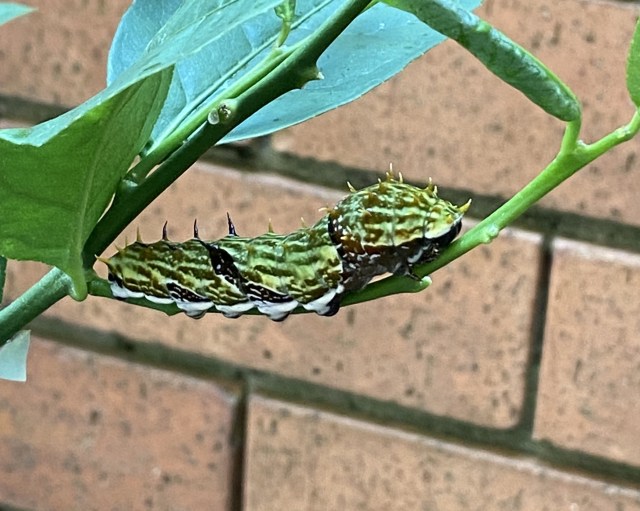
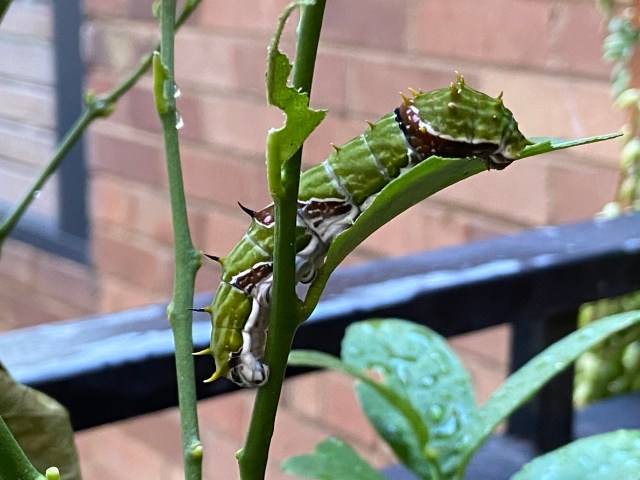
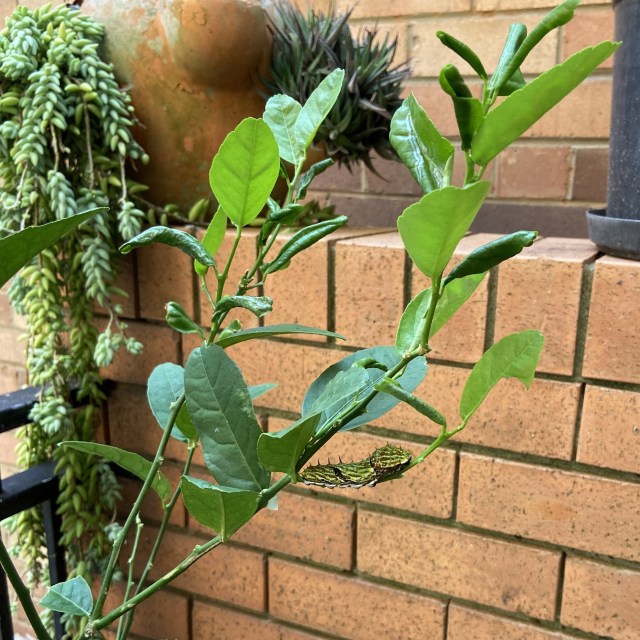
On my first day of empirical monitoring, I closely inspected the mini dragon on my dwarf lime. This is the Orchard caterpillar, the early-stage larvae of the Orchard Swallowtail Butterfly. It’s most commonly found in woodland areas across eastern Australia and, as a result of my laissez-faire gardening philosophy, it seems our balcony can now be classified as such. Because I felt an unscientific attachment to my  lime tree, I faced a difficult dilemma, do I save the butterfly or do I save the tree? After all, if there is no tree, can there be a butterfly? Or does the butterfly beget the tree? Where does the tree end and the butterfly begin?

I’ve written about my first encounter with the Orchard caterpillar in Lepidoptera where I decided to save the tree. The distressing memory of committing lepidopteracide leaves me only one choice this time – to save the butterfly.  So, I decided to watch and wait.

A few days later, the caterpillar began its next instar, as the developmental stage of an arthropod between moults is called. Because nothing much happens while watching a caterpillar, I was augmenting the experience with regular forays onto the internet. I was learning a lot while saving the world’s butterflies, in particular that although so many butterflies are endangered, the Orchard Swallowtail is not. It has successfully adapted to feeding on citrus trees. Whilst pondering whether I should actually be saving the lime tree instead, the caterpillar turned a shade of unripe green but kept its horny scales.

The next day I discovered that I’d be saving two butterflies – another caterpillar had joined its little friend for dinner. Between them they’d eaten half the lime tree overnight. I watched them for several days as they continued to feed, until the first one was almost the size of the tree itself.
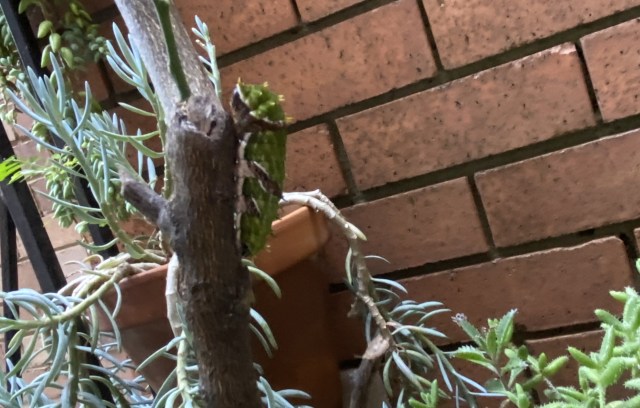
It was shortly after this that it began its metamorphosis from caterpillar to pupa. This experience was not unlike reading a Kafka novel. It began with a journey down the trunk of the lime tree.

And the next day, while its flatmate was still munching, I discovered it on the slim trunk of the bottle brush next to the lime tree. It had lost almost half of its weight and was conducting a kind of dance with a thin thread that it had emitted from its spinneret; a silk spinning organ much like a spider’s. It was like watching an abseiler rappelling on a rock face. By that evening it had completely encased itself inside a chrysalis. Now this was a skill that I envied.

A few days later, the other caterpillar carried out a slightly less graceful version of the transformation that looked more like it was having a little fit. Alas, when I turned up for morning observation the next day, this caterpillar was nowhere to be seen. Had it been blown away by the wind? Perhaps it had been eaten by a bird? I felt sad that there would now be one less butterfly in the world. And a little guilty that I’d dissed its efforts.

To add to this tragedy, on my next daily patrol I noticed a little hole, about half a millimetre in diameter, in the cocoon of the first caterpillar. On closer inspection, I could see the light shining through the now translucent shell. There was no pupa. And there would be no emerging butterfly winging itself into the world. I didn’t know what had happened, but I suspected the pesky ants I’d noticed zipping up and down the branches had something to do with it.

Turns out I hadn’t saved either butterfly but I consoled myself that at least I had half a lime tree left. And that’s when I noticed, out of the corner of my (do you not gawp in amazement sometimes at just how many things seem to go on at that angle) a very small movement which alerted me to a very large problem. I turned my head, just slightly, and there, on what had once been a lime leaf, was a new monster!

The next day, the tree looked like this!

While I’d been logging the life cycle if its siblings, it had been logging my tree! This creature had swallowed the other half of the lime tree and seemed intent on devouring the whole forest. And it was not a gracious guest. It had left a huge mound of small pebbles on the leaf below it, attesting to just how much it had eaten over night!

Even though I can easily identify bird poo, dog poo, cat poo, cockroach poo, kangaroo poo, wombat poo, lizard poo and human poo (with all its arbiters of digestive issues), I have never seen giant caterpillar poo.

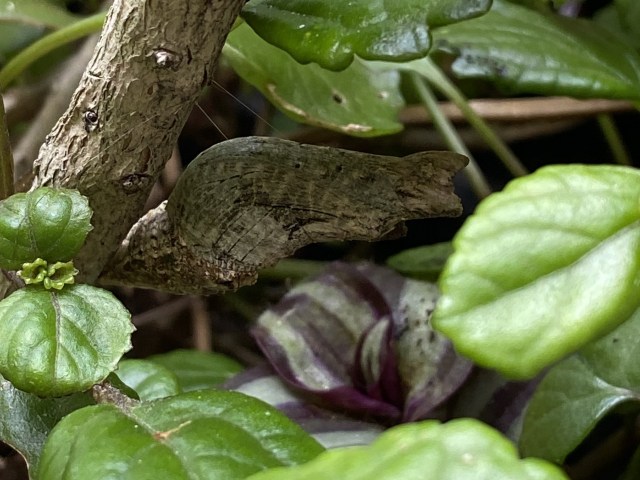
I was faced once again with the moral question: do I save what’s left of the tree or wait in hope that this time a butterfly would emerge? I decided to procrastinate instead and do a little scatalogical research about this creature. Fortunately, I was saved from making a decision because by the time I returned to my observation post, the caterpillar had travelled the length of the tree, crossed a land branch and migrated to the nearby bottle brush tree where it had attached itself, like a small green sickle moon, to the trunk.

Forty-eight hours later, it had spun itself into a green tinted chrysalis carefully camouflaging with the branch so that only a sharp-eyed citizen naturalist would be able to spot it.

Where does the tree end and the butterfly begin?

I’ll meditate on this ontological question over the next few weeks, as inside the chrysalis the caterpillar dissolves its former self and transforms into a butterfly, emerging for only the length of a season to make our world its garden home.

Posted in Habitat, The Animal Kingdom, Writing Nature and Place | Tagged , , , , , , , , , , , , , , | 4 Comments

The Animals That Chose Not to Kill Me This Summer

Three weeks before year’s end, we set off on a long-looked-forward-to summer holiday, conveniently forgetting that Australia is home to some of the most dangerous animals on earth.

Naively excited, as only the normally deskbound can be, we left the safe familiarity of our city behind and drove south along the Hume Highway, stopping only for second breakfast at Bundanoon, morning tea at Goulbourn, elevenses at Gundagai, lunch at Tarcutta and afternoon tea at Holbrook, finally arriving at the border town of Albury, and pausing for a well-deserved bite to eat, before crossing the Murray River. We reached Bright an hour before day’s end, with enough light left for a picnic supper on the banks of the fast-flowing ice-cold river of this pretty little Victorian Alpine town.

Bright sits at the edge of Mt Buffalo National Park, so the next day we packed our lunch boxes and trekked to the summit of The Horn, eerily reminiscent of Mt Doom in The Lord of the Rings.

The next part of our road trip took us south east along the Great Alpine Road, through picturesque Harrietville, nestled at the foot of the range on the Ovens River, before climbing up to Mt Hotham and Dinner Plain, both with spectacular views across to the Snowy Mountains and Mt Kosciusko.  

In the late afternoon, after a long snaking drive down to sea level we reached our destination: Lakes Entrance, which sits at the mouth of the vast Gippsland Lakes that run parallel to Ninety Mile Beach at the edge of the Tasman Sea. This is where our seaside holiday would begin.

So far it had been the perfect trip, except for the scarcity of country bakeries on the journey through the high country. However, our first day in Lakes Entrance provided ample opportunity for that kind of indulgence before we explored the nearby beaches. Our favourite was Lake Tyers beach and although the temperature hovered in the early 20s and the beach was deserted, only us and a hand full of gulls, we were determined to brave the ocean for our first swim of the season.

I stepped into the water, expecting the heart chilling temperature we’d encountered last year at beaches further west near the border of Victoria and South Australia, but was wonderfully surprised. The sea here was simply invigorating. I felt like all the daily stresses of working and living in a big city were being washed away. I wanted to play in this aquamarine paradise forever but streaky clouds had begun to blow across the sky and were now playing hide and seek with the sun, turning the water dark blue and obscuring the sandy bottom. Deciding it was time for lunch, we let one final wave carry us onto the sand. Little did we know that we weren’t the only ones looking for a feed. On the way back to the car park, at the crest of the sand dune path, I turned for a last look at the ocean, and there right in the shallows, where we’d been swimming only minutes before, was a large black fin. It zig-zagged quietly through the water never veering from its lethal trajectory. We had almost crossed the path of this deadly beast.

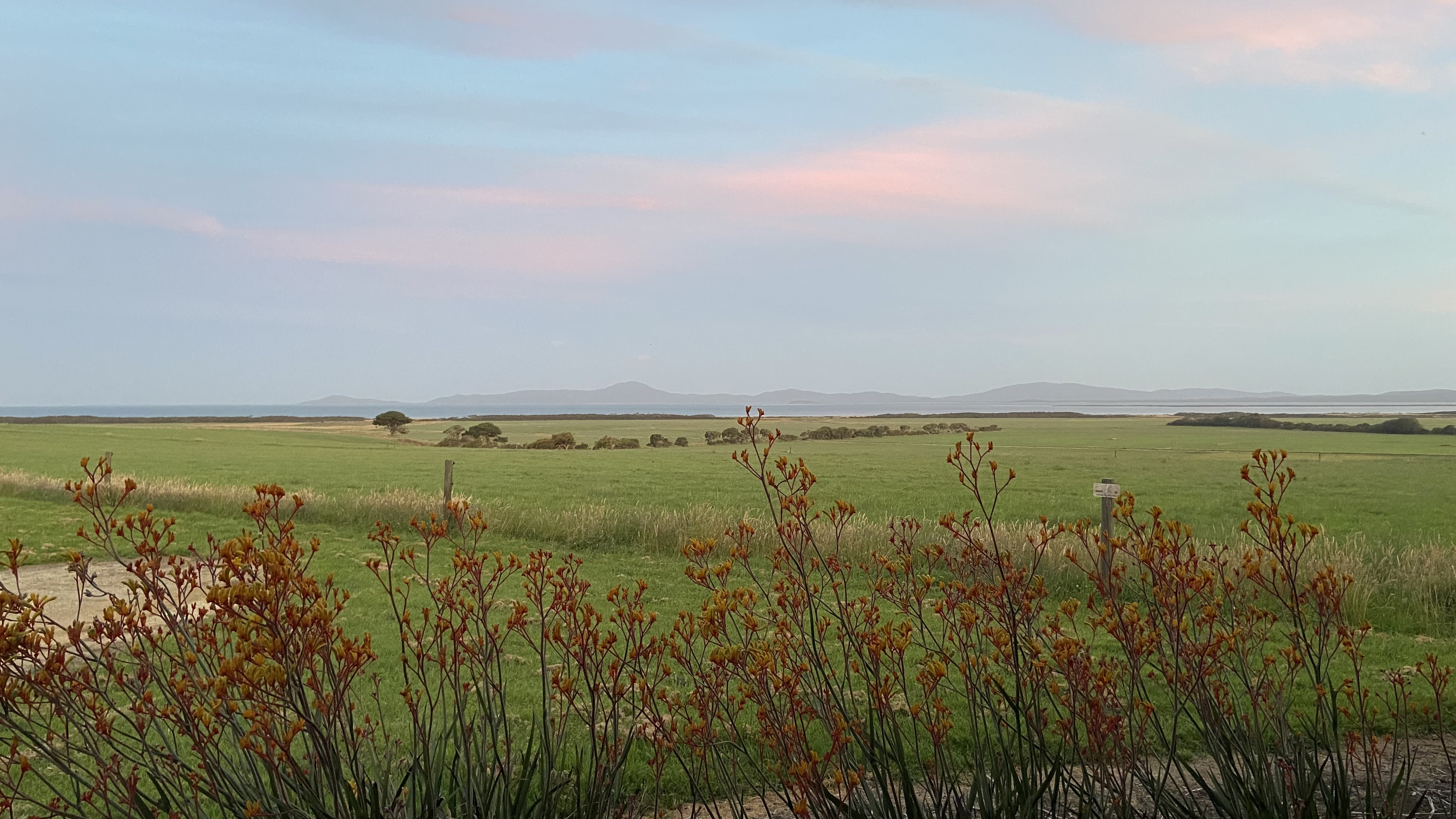
At the other end of Ninety Mile Beach is Wilson’s Promontory, which juts thirty-five kilometres south into Bass Strait and on its edge is the tiny locality of Yanakie where we had driven to after our time in Lakes Entrance. Our little cabin had a stunning view of this beautiful mountainous national park; a perfect place for walking in winter and edged by white sandy beaches, perfect for swimming in summer but I wasn’t planning on swimming again any time soon. Each night as I’d drifted into dreams, I’d seen that black fin cruising at the edge of the water. And during the day as we explored the region, I couldn’t help thinking about our near miss.  

Over the next few days, we visited Squeaky Beach, named by Tourism Australia in 2024 as the best beach in Australia. We explored Whisky Beach and Picnic Beach and Norman’s Beach, all breath taking. How could we not swim here! But fear kept us out of the water. As we stood on the sandy access track to Cotter’s Beach looking longingly at the turquoise sea, I noted a strange movement from the corner of my eye. Turning slowly, I saw an emu, standing in the dune grass staring at us quietly. And then I noticed another one, and another, and another… all together I counted twelve! We stood still, hardly breathing, until one by one the whole mob wound their way slowly behind the shallow sand hills and disappeared from sight. I was elated to have seen these giant flightless birds that were happy to roam the sand dunes without ever being tempted to step into the water.

Later that afternoon, we found ourselves walking along a forest path near a mangrove inlet called Millars Landing. At a curve in the track, just past what it was easy to believe had once been a set of worshiping rocks, I spotted a small skink lizard. I could see its little heart beating hard as it waited for us to move on. Moments later we stopped again, standing dead still and silent, listening to a soft rustling sound in the ferny undergrowth. A few meters away, warily watching us, was a beautiful chocolate brown swamp wallaby. Eventually it lost interest in us and turned back to its foraging. But before I could take a step, my partner grabbed my arm. I froze. Just in front of us, at the edge of the path was a long thin snake with grey brown stripes. My heart began racing frantically as I held my breath. After what felt like a lifetime, it slid slowly and silently across the track and into the low bushes. We watched it move well away before stepping forward again. We had just missed another deadly encounter. Had we not stopped to look at the wallaby we might have stepped right into the path of a highly venomous tiger snake.

With such convincing evidence that it was even more dangerous to stay out of the water, we got straight into the car and drove quickly back to the best beach in Australia, changed into our cossies and ran into the surf. After all, what were the chances of two sharks being in exactly the same place as us?

The final part of our holiday was spent at a stunning beach house at The Honeysuckles near the town of Sea Spray right on Ninety Mile Beach. So, it was convenient that we’d gotten over our shark phobia. The Honeysuckles is a tiny locality, nestled between sand dunes and wetlands, boasting unsealed roads and no street lighting. It’s a place that feels removed from the progress of time, where each night the Milky Way with its hundred billion stars seems to hang within touching distance, and the cool sand of the beach is lit only by otherworldly light.

Each day we lay on the warm sand watching the rolling surf stretch forever to the east and west, with nothing but sea before us all the way to the southern horizon. We had the unpatrolled beach to ourselves as we splashed and played in the waves like a couple of wild children. It was on our second last day, once again as we were leaving the beach by a dune path, that I turned to look back at the water.  And there, like a nightmare returning to haunt me, was a black fin cruising the shallows. I couldn’t believe it. Was it the same shark? Had it followed us these ninety miles? I didn’t have any answers. All I knew was there was no way that I would be getting back in the water again! After all, how many warnings does an idiot need?

At that moment, two actual children walked past us with their surf boards. Dutifully we pointed out the shark.

“Nah. It’s a dolphin,” one kid said without even looking up. The other one had the grace to look concerned.

If this was a dolphin, it was a seriously unhappy one. 

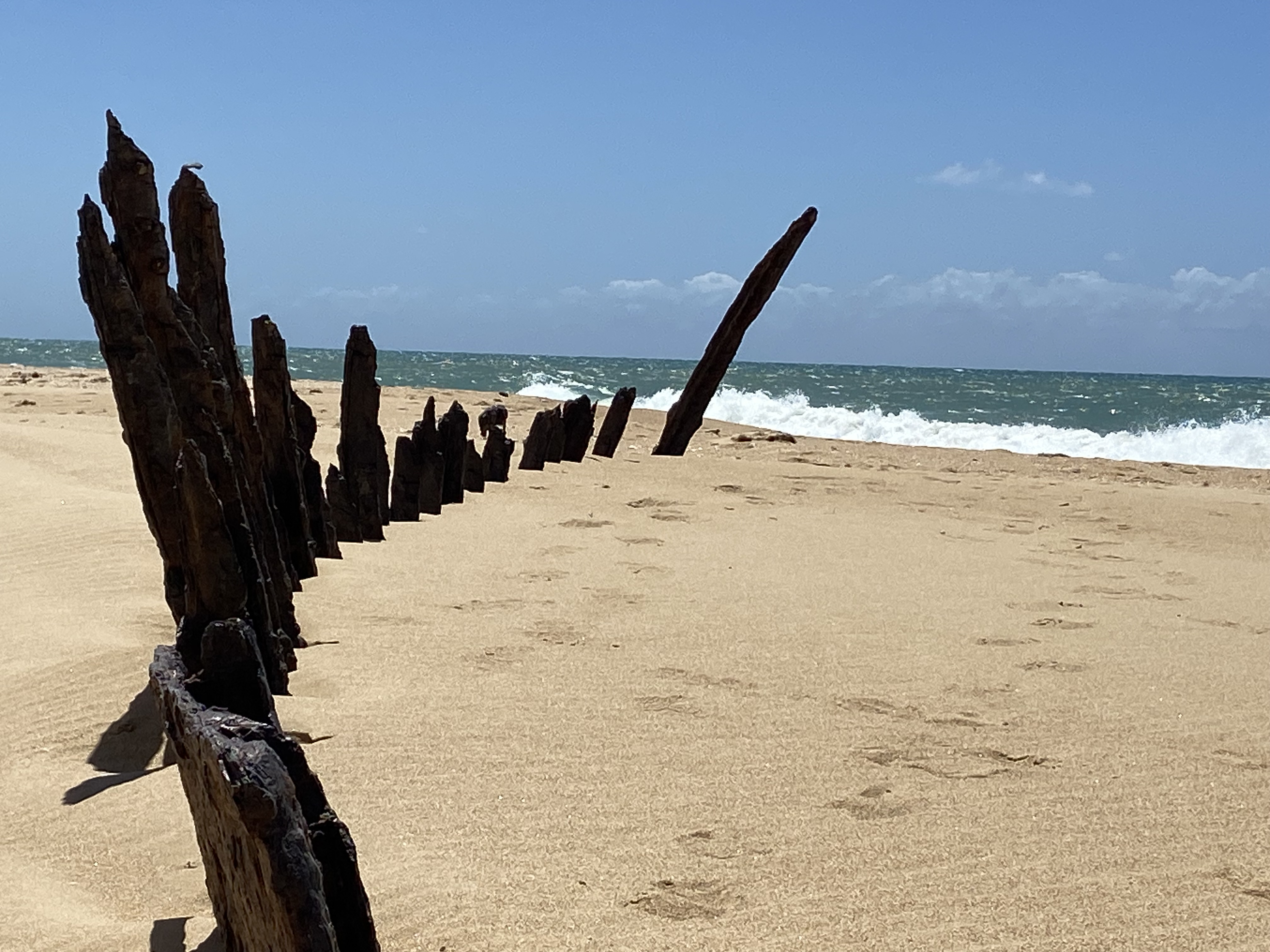
We spent our last day exploring the Gippsland Lakes Coastal Park that stretched to the east from the safety of our car. This was how we discovered the Trincullo shipwreck, the remains of an iron barque that was driven onto a sandbar by gale force winds in 1879. Miraculously everyone survived, thanks to the bravery of one sailor who leapt off the boat tied to a rope and swam through the wild, (no doubt shark infested) surf to the shore. Looking now at the iron skeleton of the boat sunken peacefully into the sand, it’s hard to imagine the chaos that passengers and crew went through. Looking now at the surf, it’s easy to imagine the sharks.

As we drove back to the Honeysuckles, we noticed some kangaroos gathered on a deserted golf course just outside Golden Beach. I turned my head to look at them, intending only to take a quick glimpse, when my passenger gasped and I jerked my eyes back to the road. A lone golden roo broke from the verge, where it had been camoflaged by the long yellow wheat grass waiting for the perfect moment to cross. It hopped gracefully across the road only a few centimetres in front of our car. I slammed on the breaks and forced myself not to jerk the steering wheel to the side as it joined its mates on the green. I cursed myself for being so stupid as to take my eyes off the road, even for an instant. Despite staying out of the water, despite staying away from bush trails, we had still managed to have an almost deadly encounter with a wild beast. Sadly, it was not to be the last.

The next day we said goodbye to this awe-inspiring part of the world and headed north on the Princes Highway, which winds treacherously, in all its single lane glory, through the mountainous south west forests of Victoria and New South Wales, until the start of the dual carriageway just south of Nowra. The holiday had ended and as my mind readjusted to reality, it kindly replayed the hundreds of news reports that I’d seen over the years about fatalities on this wild stretch of road. As a passenger, I reminded myself that we’d avoided several dangerous encounters on this trip. When it was my turn at the wheel, I tried to remain focused on negotiating the bends and ignoring the incessant tailgaters who insisted on overtaking us every time the solid white line broke (and sometimes when it hadn’t) as if chased by demented demons.

Several times this happened as we headed to the border, even though I was driving at the speed limit. Who were these people that acted on impulse, driven by their illogical desire to win against time? Were they gamblers with a death wish? Or simply lacking imagination? Apparently, the double demerit system during holiday periods doesn’t exist in Victoria. Could this be why this ridiculous behaviour seemed more common here? As I was thinking this, another driver flashed by, overtaking on the other side of the road as if we were racing in a video game. Suddenly as we rounded a bend, I noticed the flashing lights of an emergency vehicle coming towards us in the other lane. I slowed as the ambulance screamed past, flaring in my side vision like a shooting star, then slowly let go of my breath, praying hard for the life of whoever was waiting for that ambulance.

By the time we crossed into New South Wales we had definitely earnt a mid-morning break so we pulled into the aptly named far south coast town of Eden. Here, I knew from past experience, we could sample a heavenly array of sweet baked goods. A few minutes later, sipping a soothing cup of tea at a quaint country café, I contemplated the animals that chose not to kill me this summer: two sharks, one tiger snake, a very silly Roo and the most dangerous animal of all, Homo sapiens. 


Posted in The Animal Kingdom, travel | Tagged , , , , , , , , , , , , , , , , , , , , , , , , , , , , , , , , , | 4 Comments

The summer of drop bears

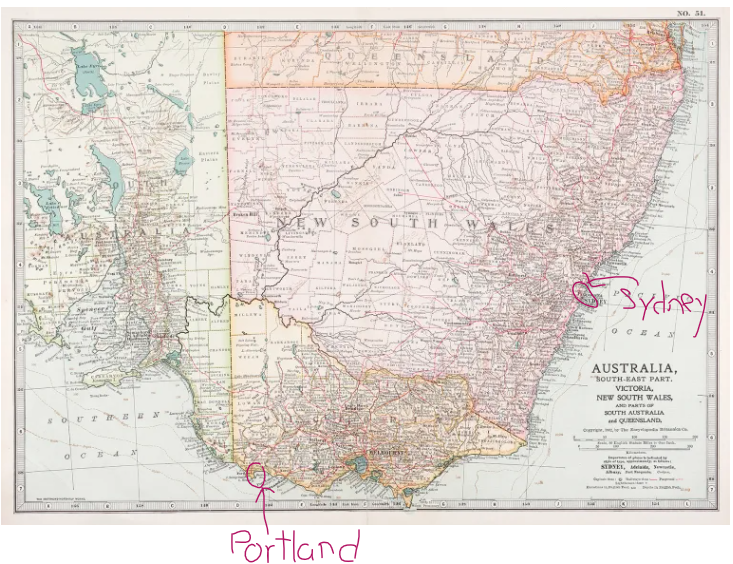
This summer, on our road trip to Portland, Victoria, I discovered that Koalas almost outnumber humans and are so common that they’re ignored by the locals as they walk down the main street. Okay, I’m exaggerating but only a little.

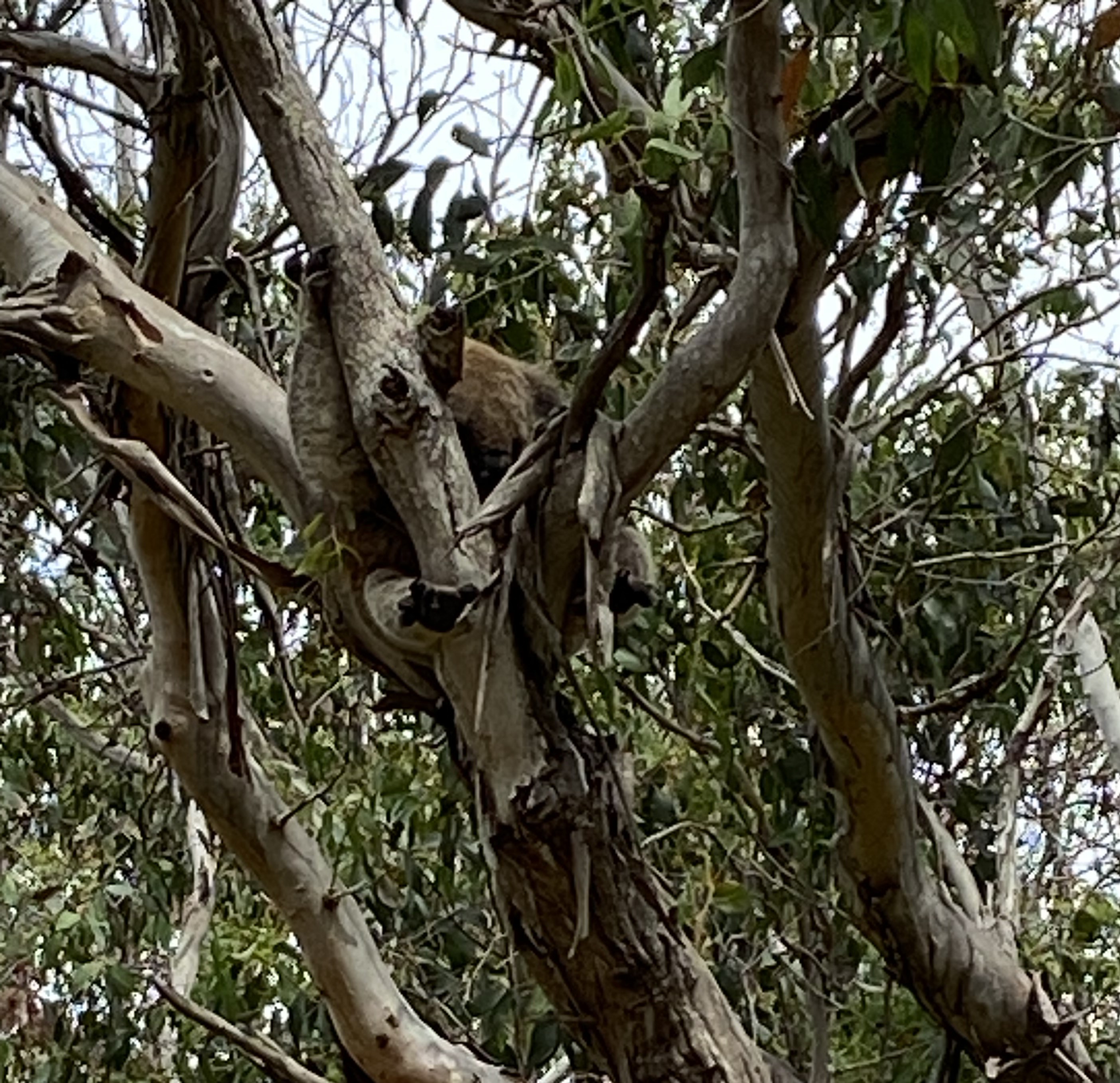
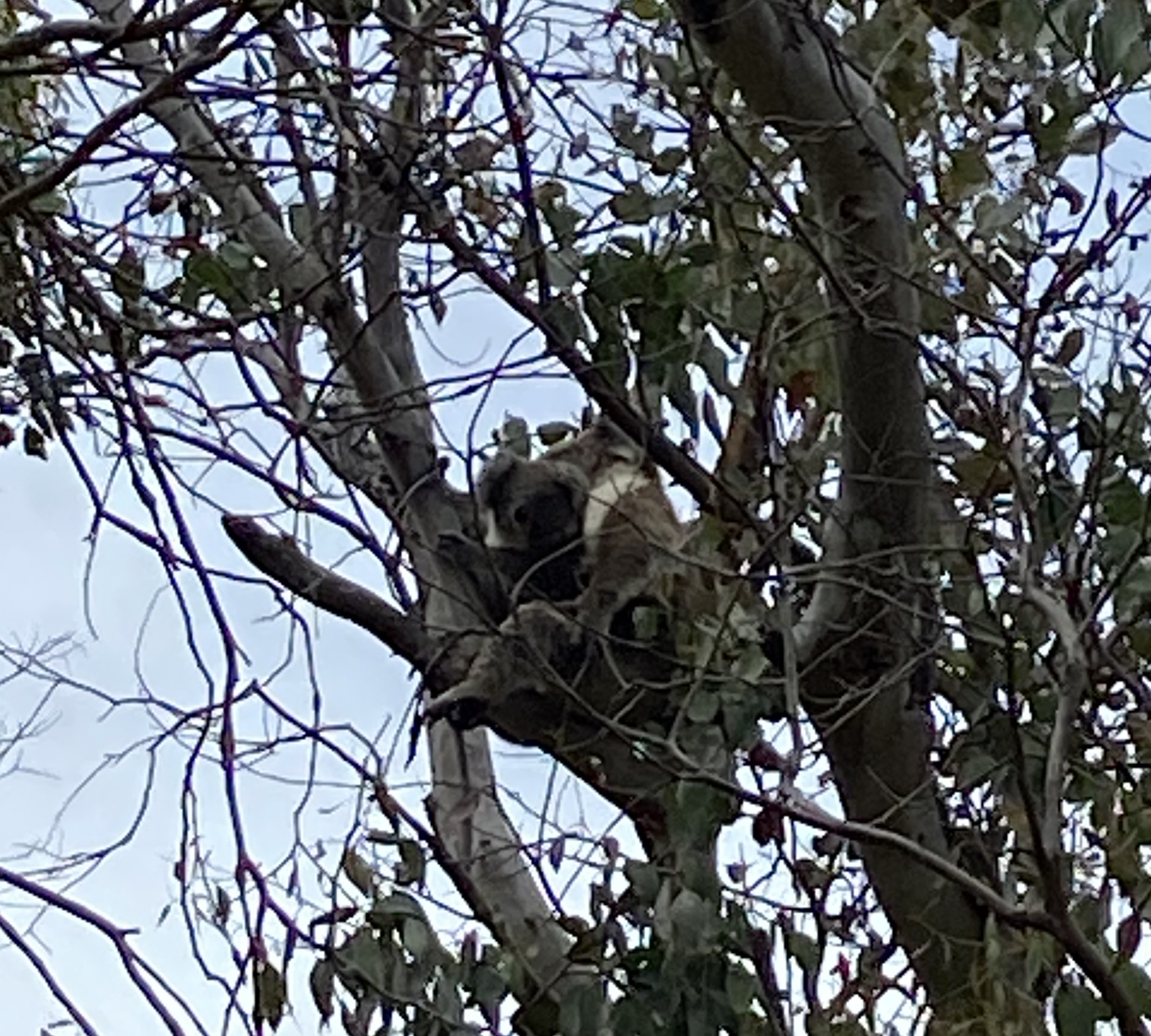
Portland is in the far south west of Victoria, a full two-day drive from Sydney and about 75km from the border with South Australia. It’s a working port, surrounded by hectares of plantation forestry, making logging trucks a common sight on the road, so you’d be forgiven if you thought there wouldn’t be too many Koalas here. But it’s also the starting point for the Great South West Walk (GSWW) a 250km loop that winds its way along coastal cliffs and beaches and through a chain of nature reserves and national parks. One of these is Mount Richmond which we detoured into on our first day on the way to viewing the colony of wild seals at Cape Bridgewater. We stopped at a pretty little picnic area, surrounded by low sprawling eucalypts that the signage told us were Manna gums, apparently the favourite food of koalas. I wasn’t expecting to see any koalas but it was nice to know what they ate. And then, in one of the trees right next to the track leading off from the picnic area, was what at first looked like a sleeping sloth. Its reddish fur contrasted with the grey of the tree branch that its claws grasped and it’s two feet were splayed out horizontally.

It was so cute. I couldn’t believe I was looking at a real life koala in a tree. Not in a photograph and not one of those stuffed toys you see everywhere. Although the resemblance was uncanny. I felt warm and sweet all over, excitement oozing from me like sap from a tree in spring. It felt like falling in love again. We stood in silent awe as it dozed, shifting occasionally, paying us no attention at all. Eventually we tore ourselves away, and that’s when we spotted two more in a nearby tree, mum and bub, this time. Mum looked at us warily then went back to sleep but the little one, tucked in safely in front of her, watched us with such sharp curiosity that I was afraid it would fall out of the tree.

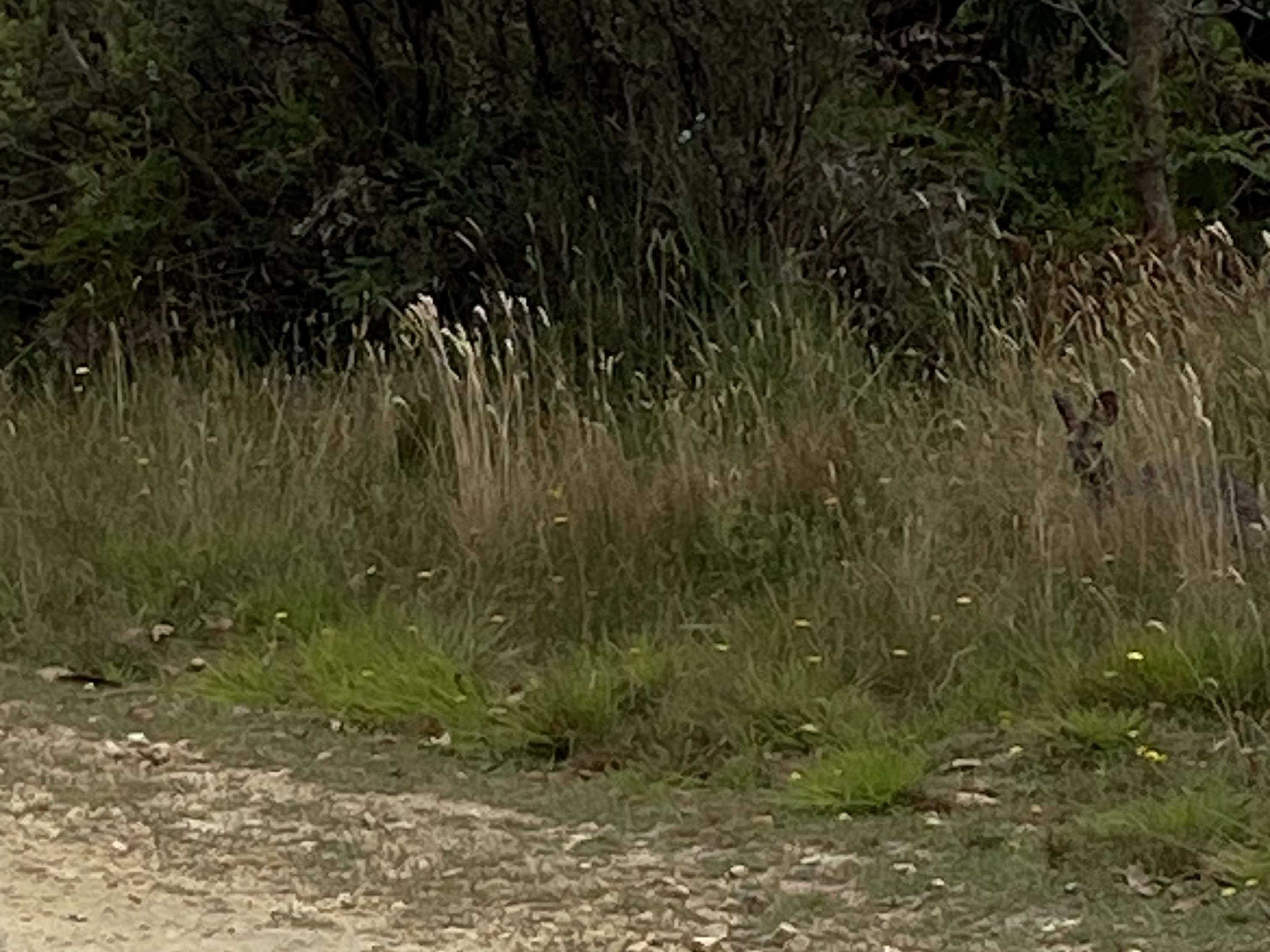
Then the very next day, while walking along the stunning Crater Rim track at Budji Bim National Park we stopped to watch a red-necked wallaby. Behind us branches snapped, and there was a loud crack but we couldn’t see anything. Just as I was about to turn back to look at the wallaby, a koala jumped out of the long grass and onto the trunk of yet another Manna eucalyptus tree. It walked out along one of the branches but then decided this wasn’t the branch it wanted to be on. Rather than reversing back the way it came, it looked longingly at the upper branches, then it crouched down and just as my partner whispered, “It’s going to…” It jumped, springing across the gap between the branch and the trunk, landing not too shabbily and then making its way up to the very top of the tree. This was like having front row seats at Cirque du Soleil. I didn’t want to walk away from this amazing animal display but for the second time in as many days I was afraid that I’d witness a koala falling from a tree.

The Gunditj Mirring people are the traditional owners of Budji Bim National Park which is an extinct volcano and a few kilometres away are the remains of the ancient aquaculture engineering that was practiced here for thousands of years. The park is on the UNESCO World Heritage List. Reluctantly we left this beautiful place to drive back to Portland. We were approaching the hamlet of Narrawong, just 16km out of Portland, when we had our third encounter. My partner had slowed down the car thinking there was a wallaby on the side of the road, but as we approached we discovered yet another koala emerging from the high grass before disappearing into the scrub beside the road. This couldn’t be possible. How could this place have so many koalas and all of them intent on being noticed. One koala sighting was incredible. Two, extraordinary, but three? Was this a joke? Were we on candid camera? But it was the next day when things got truly out of hand and I found myself unintentionally trying to rescue a koala that had other ideas.

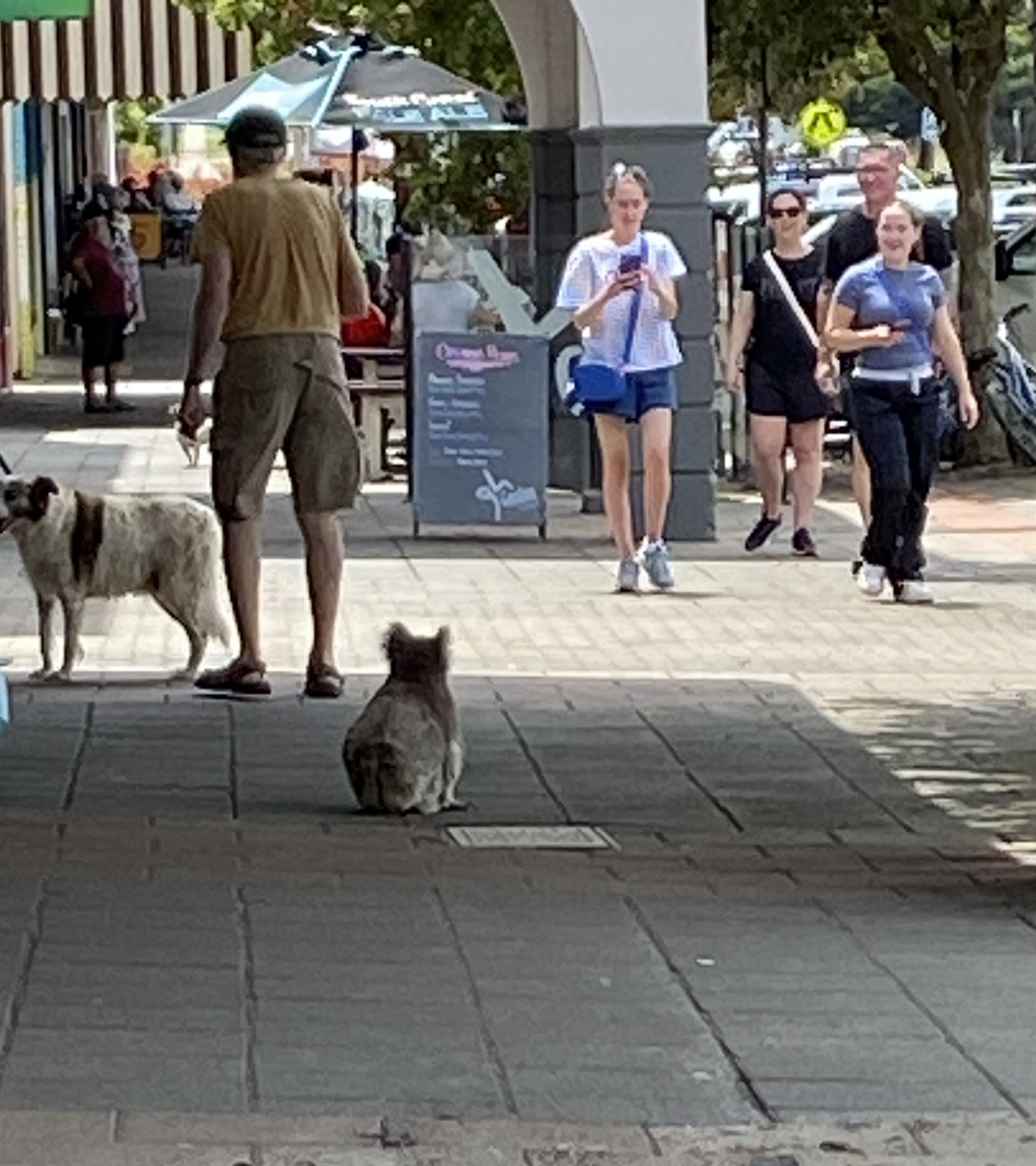
I was browsing through the $2 box outside the second hand book store on Portland’s main street when a koala walked past me along the footpath. Yes. Hard to belive but true. It stopped to pose for passers by like a celebrity on the red carpet. Then it took off at quite a pace, past several shops and cafes, heading straight for the street corner. People kept taking photos. I think we all expected a local to step in and do something: pick it up, cordon the area off, call the police? But nothing happened. People kept standing by, cameras kept clicking and the koala kept heading for the road. This was no docile herbivor like the others we’d seen. This was more like the dreaded drop bear of Aussie folk legend designed to put the fear of God into the hearts of unsuspecting tourists. Although this one was failing at fear and winning at legend.

I followed it, edging through the crowd that had now gathered around it, trying to get a better look and suddenly found myself right next to the furry creature. That’s when it decided to step out onto the road. A four-wheel drive towing a caravan was approaching. It wasn’t slowing down. Could it not see what was on the road? So, instead of minding my own business, I too stepped out onto the road, planted myself on the white line in the middle and started madly waving. Rather than stop, the driver waved madly back at me, telling me to get off the road. I could see people still taking pictures and soon they would have one of me and the koala, both flattened on the road.

Luckily, that’s when my partner chose to step out and start waving as well and this convinced the mad man to come to a halt. Meanwhile the koala continued, with kamikaze intent, its odd lope across the road. It had never occurred to me until this moment how closely koalas resemble Tasmanian devils with their uneven awkward gait – one leg shorter than the other three. That’s probably because I’d never seen so many of them before or been close enough to study their walking habits. I was starting to wish I wasn’t so close to one now. At least it wasn’t a Tassie Devil. There’s no way I’d risk my life to help one of those snarling beasts. It would have taken off one of my legs by now. But perhaps that would have been a more effective way of stopping the traffic. Now, a red sedan that had initially stopped on the other side of the road, began to inch slowly forward. The driver, gobsmacked by the sight of a koala crossing the road in the middle of town, had taken his foot off the brake. Luckily, both the koala and I had reached the other side of the road. I breathed a sigh of relief just as a young woman appeared by my side. It took me a moment to work out what she was doing because she wasn’t taking photos with her phone. She was using it in the traditional way and talking to someone. WIRES? A wild life sanctuary?  As she hung up, she turned to me in frustration, “I called the police. Do you know what they just said? ‘Lady, this happens all the time.’ What do we do now? We can’t leave it here.”

It seemed the koala agreed and chose that moment to cross the road once again, back the way it had come. This time the traffic was much more responsive. Perhaps word had got around town that there was a crazy lady on Portland’s main street. It ambled comfortably back across the road and posed in front of the once again snapping crowd outside the cafe, then made its way to one of the street trees, that were not Manna gums, or eucalyptus trees, or even native Australian trees, climbed onto the trunk and disappeared up into the canopy of leaves. The crowd dispersed and I made my way back to the bookstore. Inside the owner greeted me. I asked him if he’d seen the koala. He chuckled and said that he kept the door closed because otherwise it came inside and he had trouble getting it back out. Fortunately that was our final koala sighting of the trip. We saw seals, giant stingrays, emus, more wallabies and roos, Pacific Gulls, Gannets and a whole menagerie of birds but not a single other koala. They had obviously had enough of us too.

Images: Map of South East Australia, C1903, Sir William Johnston (1802 – 1888) Collections: National Library Australia; Volcano Rim Walk at Lake Surprise, Budji Bim National Park, via Wikimedia Commons; Bentinck Street Portland Mattinbgn, via Wikimedia Commons; Koalas and sun set by sagesomethymes.

Posted in The Animal Kingdom | Tagged , , , , , , , , , , , , , , , , , , , , , | 4 Comments

The Pleasures and Sorrows of Time Travel

I’m going on a memory walk, retracing the path from Redfern Station to Sydney University that I traipsed daily as a student over thirty years ago. I’m in the mood for a little time travel.

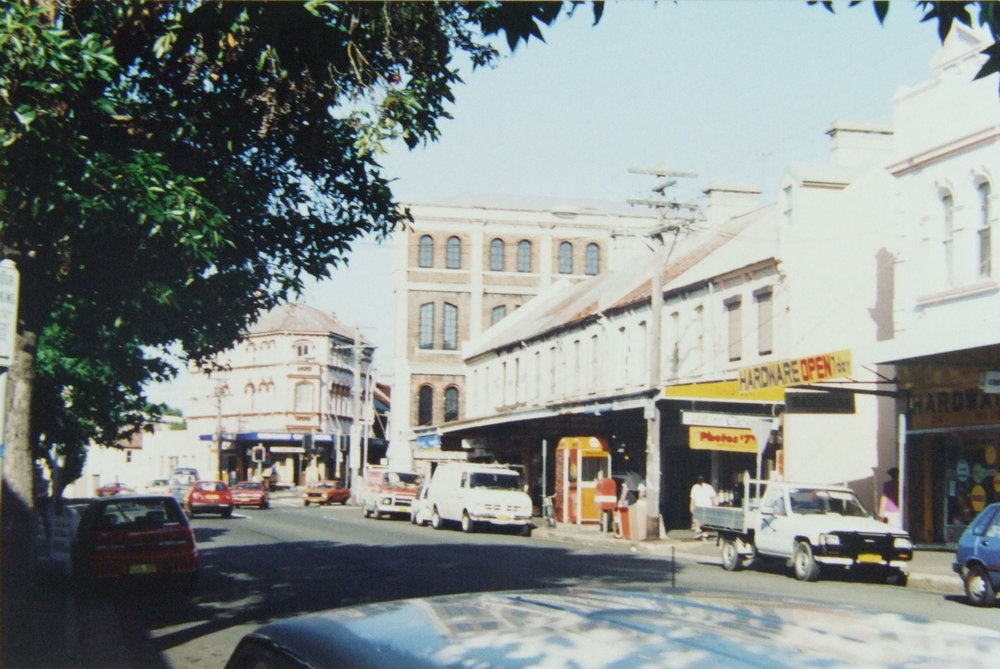
Walking along the narrow footpath on Lawson Street, surrounded by university students, I instantly feel younger. But as I turn left at Abercrombie Street I can see that things have changed. There are a couple of busy coffee shops, a dry cleaner and a hairdresser. People dawdle in smiling groups, sipping coffee from takeaway cups, laughing and slapping each other on the back. All this bonhomie instantly makes me feel older. I think back to the late 1980s when to find a coffee you had to drive to one of the faux-elegant, migrant owned establishments, like George’s Cafe in Newtown or Cosmopolitan’s at Double Bay. This is where you met up with friends and talked late into the night. And ate enormous slices of carrot cake or lemon meringue. Coffee was a special occasion. You didn’t just grab a cup and sip it on the sidewalk while talking to friends on the way to uni. In fact, friends were a special occassion. Now everyone seems to have hundreds of them. But back then Darlington was no place to hang around. Most of the shop fronts on the street were curtained private residences or hidden behind grey roller shutters. There was one dark little takeaway shop but it didn’t sell coffee. And no one ever bought the food. The only reason you’d step inside was to find primary evidence of the deep past for your History assignment.

Past the coffee shops and terraces, I stand at the spot that used to be a pedestrian crossing but is now a speed hump. Then, as now, hundreds of students walked this way each day. Mounted police coordinated the crossing each morning. I remember the first time I came here, waiting obediently to be allowed to cross, awed by the magnificent beast I was standing next to. The horse not the officer. I’d never been so close to either before. Now a set of traffic lights has been installed on the nearby corner of Shepherd and Abercrombie Streets. Although equally efficient, they don’t elicit quite the same excitement as I cross and walk down the gentle slope of Shepherd Street to Gate 2, the university entrance.

Here a curved wooden boardwalk, edged on one side by thin steel blades the colour of weathered iron, evokes the nearby engineering faculty and mirrors the steel and iron struts that are stacked on the tarred driveway below. The driveway leads to a car park lined with paper barks. I don’t remember the boardwalk or the paper barks. We were made to walk along a concrete path, surrounded by a jumble of concrete and brick buildings and corrugated iron sheds. This walk was ugly. One of the many reasons I spent hours in the library escaping into the pages of books about beautiful places like Paris and Rome. It seems that time does work miracles, because now this place has a rustic beauty. At the other end of the boardwalk a pair of sprawling Hills Figs meet overhead and as I walk under their low hanging branches I emerge into an open space. There are wooden sun lounges planted between the slim grey trunks of the lemon scented gums that edge a circular green. This place has changed so much it’s unrecognisable. Is this a mirage? Or am I experiencing the onset of dementia? This time travel thing might be dangerous.

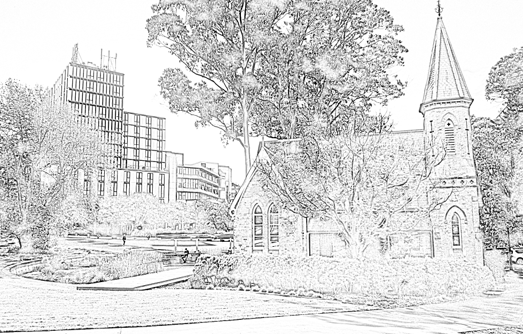
I stare at the reed filled lake, surrounded by a stone retaining wall, that sits at the hollowest point of the green. At its edge is a beautiful old Victorian building with gable facades and a spire. Did the blokes that put together the sun lounges build that too? And why is it here and not on the set of a Harry Potter film where it obviously belongs? The building has church like arches on the windows but I don’t think it’s a church. It looks too substantial, too tethered to the earth for a liminal place. I spot a sign and decide to put my university education to use. It tells me that this is the Old Darlington School House built in the late 1870s. Apparently in the late 19th century, the quiet green space before me was the Darlington town centre with a post office, a town hall, over four hundred houses, almost thirty shops, fifty factories, five pubs, a dance hall and a public school.1  It was one of Sydney’s poorest suburbs which by the late 1940s was labelled a dangerous slum. The university made plans to acquire the suburb but locals, led by activist Freda Brown, protested. They lost the battle and their homes were torn down for what became the Darlington campus which still holds the shadow of the original street patterns within it. The old school is the only building that survived.2

Wow. Now I feel even stranger. Perhaps it was the place I knew as a student that was a mirage. I feel like I’ve never been here before, but the Molecular Bioscience building, the only part of this scene that existed when I was a student here, proves me wrong. I do remember climbing the concrete steps of this Brutalist giant every morning and walking through the Wentworth building and then over the footbridge to the main campus. That same building now creates a border on the southern side of what has been named Cadigal Green. The name harks back to the pre-1788 landscape. Apparently the Indigenous people called it ‘Kanguroo Ground’ before it was unceremoniously taken by Governor Arthur Phillip for the use of churches, schools and grazing animals.3

I feel embarrassed that I didn’t know any of this history at university. I was studying the history of far off places but completely ignorant of the local history of the place I walked in every day. I knew about the rise and fall of Communism across the globe and the 1951 referendum to ban the Australian Communist Party but had no idea that Lawson Street and the suburb of Darlington were once the haunt of some of those very communist activists that had helped to defeat that referendum. I was reading about the civil rights movement in the USA and the freedom rides and 1967 referendum in Australia without connecting any of those events to the Aboriginal people in Redfern, the suburb that I travelled to everyday. And even though I was a fierce feminist, I’d never heard of Freda Brown who throughout her life campaigned for social justice in places like South Africa, then under Apartheid; Afghanistan where she helped women to learn to read; Vietnam during the Vietnam war; and Cuba and Moscow during the Cold War; but also, close to home where she lobbied for equal pay for women and proposed the United Nations International Women’s Year, which was held in 1975 and became the precursor of International Women’s Day.4

Feeling a little lightheaded, I sit down on the edge of one of the sun lounges. Then I lift my feet off the ground and swivel into a lying position, looking at the deep blue sky through the filter of eucalyptus leaves. It’s as if I’ve stepped into a time machine and been whizzed back across the centuries. A place that I thought I knew intimately has been revealed to be a complete stranger. Who knew that time travel could induce travel sickness. Like the naïve everywhere, I’d assumed that what I walked through each day had always been the way I was seeing it. And I also assumed that it would never change. I close my eyes for a few minutes and let the sun warm my face. All those years ago, as I trudged through that old concrete jungle, I could never have imagined that one day I’d be lying here sunbaking. The nausea has receded, replaced by a glimmer of hope. Or is it hunger? It’s time to make my way back to the board walk. It occurs to me that a walk through our memories can re-enchant our world and reinvigorate the digestive system. I feel the distant past merge with all the pasts since, including mine, endlessly recreating the story of this place; rendering the enormity of history down to a human scale.

Back on Abecrombie Street, I realise I’ve thoroughly enjoyed my morning of time travelling. This walk has inspired me to journey back to other places from my past. But first, I step into one of the cafes and order an enormous slice of cake and a coffee.

Footnotes: 1sydney.edu.au/documents/about/heritage/gcp_chapter2.pdf; 2 University of Sydney Grounds Conservation Management Plan, Clive Lucas. majorprojects.planningportal.nsw.gov.au; 3sydney.edu.au/documents/about/heritage/gcp_chapter2.pdf; 4nla.gov.au/nla.party-713097.

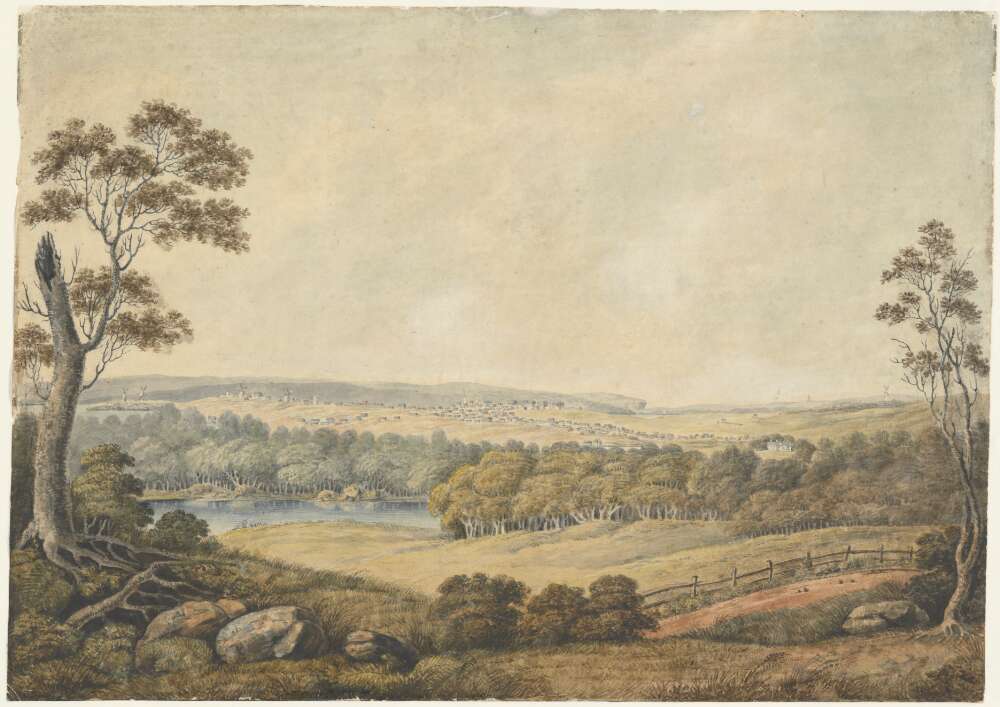
Images: Abercrombie Street, Darlington, courtesy of City of Sydney Archives; Old Darlington School and Cadigal Green, writer’s own; Darlington Post Office, courtesy of City of Sydney Archives; ‘West view of Sydney taken from Grose’s farm, New South Wales’ 1819 by Joseph Lycett, courtesy of National Library of Australia; Freda Brown, German Federal Archive via Wikimedia Commons; Coffee and Cake via Wikimedia Commons.

Posted in Spirit of Place, walking | Tagged , , , , , , , , , , , , , | 4 Comments

The Adventures of an Aeronaut – Stories from Prince Alfred Park, Sydney

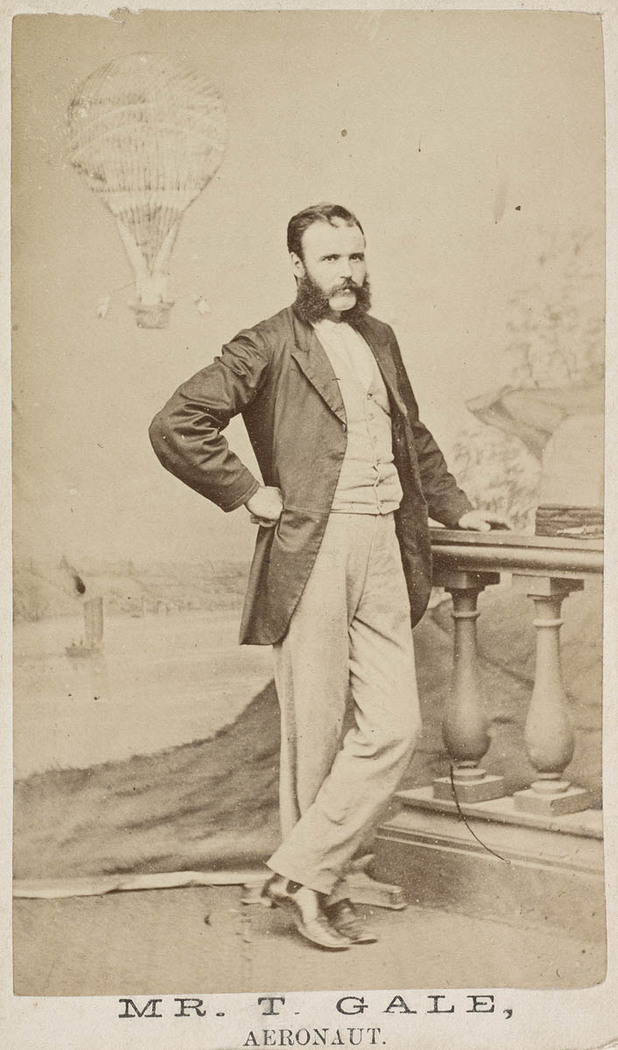
It was an overcast September afternoon in 1870 as Thomas Gale waited for his balloon to fill so that he could make good his promise to take to the skies. Gale could feel the excitement of the huge crowd around him. They were at the Intercolonial Exhibition in Prince Alfred Park, Sydney to see the famous British aeronaut, who had made over seventy balloon flights in his career.

Gale’s was not a hot air balloon, but powered by highly explosive gas, likely hydrogen. Lighter than air, but more expensive, gas got balloons off the ground more easily than air and once away, they stayed up longer.  But despite his experience and outer calm, Gale was tense. His most recent attempt, only days earlier, had failed because of the weather. Now, as he watched, a shower of rain soaked the fabric of his balloon making the oiled over cotton bandages that it was constructed from a lot heavier. There was not enough gas to fill a heavier balloon and Gale knew that an enthusiastic Exhibition crowd could quickly turn into a disappointed, riotous mob.

So, he made his decision. He removed the basket from the balloon, told his no doubt disappointed passenger that he would be left behind, and for good measure, took off his wool jacket; lightening the load to ensure his balloon would fly. Accompanied by jubilant cheers, Gale jumped onto the hoop, the cables were freed, and the balloon left the ground. Lifting up into the air it caught the breeze and began its drift to the south with the balloonist clinging to the ropes as the delighted crowd watched.

His aim was to make it to Botany Bay. But suddenly, about a kilometre from the park, where the suburbs of Waterloo and Alexandria meet, the wind dropped and his airship was becalmed. When finally a southerly breeze propelled him back towards Redfern the crowds in the park saw the balloon returning and rushed to meet him where it came down. They hijacked a horse driven furniture van to transport Gale and his balloon back to Prince Alfred Park. Although disappointed, Gale was determined to continue his aeronautical experiments.

Thomas Gale’s father was also a balloon aeronaut. He crossed the Channel from England to France in 1850. That same year he attempted another daring flight. Rather than attaching a basket to his balloon, he attached himself, on the back of a horse. I have trouble imagining how this was possible. But he managed not only to take to the air but also to land successfully. However, as he touched down, his assistants released the horse and accidently let go of the balloon, with the aeronaut still attached to it. It lifted off again with Gale Senior clinging to the ropes. Although he was able to let gas out of the balloon and direct it to land, he couldn’t control the outcome. His body was found the next day near the half-inflated balloon. His newly widowed wife was left to look after their eight children.  Twenty years later, his son, Thomas Gale, ascended into the skies above Prince Alfred Park. I can’t help but wonder what possessed him to also take to flying balloons knowing how his father’s adventures had ended.

In June of 1871, just short of a year after his flight from Prince Alfred Park, Thomas Gale met the woman that he would marry while preparing to take to the skies over Adelaide. To keep the gathered crowd entertained while they waited for the balloon to fully fill with gas, Gale welcomed a small group of onlookers to join him in the basket. The tether rope was loosened as far as it would go while still restraining the balloon. To the delight of the crowd and the lucky thirty or so in the basket, the balloon rose into the air. One of the passengers was Lavinia Balford. She became the first South Australian woman to ride in a balloon, albeit only sixty metres above the ground, and a little while later she married the aeronaut. They lived in Adelaide for the rest of their lives. Thomas continued his aerial adventures, taking passengers on many of his flights and inspiring other aeronauts to daring feats in the skies. He made some money, but also a lot of debt, which landed him in the Adelaide Insolvency Courts in 1879 where he was declared a bankrupt. I suppose his fate could have been worse.

About a week ago, coincidentally 153 years to the day that Thomas Gale ascended into the skies from Prince Alfred Park, I took part, along with thousands of other like minded people, in the ‘Walk For Yes’ rally. It’s route took us right past the very spot where Gale waited for his balloon to fill on that September day in 1870. When I mentioned this coincidence to my walking companion, I was reminded that there is a children’s playground in the park in which there is an elephant and a balloon. Neither of them are real. On close inspection though, you can see that the trunk of the little grey elephant is a slippery dip and the balloon is a steel climbing structure. Next to the balloon and the elephant, on its own small beach of sand, is a pretty, grey and green row boat, with the name Galatea stencilled on its stern. This was the name of Prince Alfred’s ship, and the baby elephant, named Tom, was gifted to Prince Alfred, Queen Victoria’s son, the Duke of Edinburgh, on his stopover in India. He was on his way to Sydney to attend the Great Exhibition which was held in this park. Both Prince Alfred and Tom the elephant were in the park on the same afternoon that Thomas Gale set off on his adventure across Redfern. I have wondered at the courage of the Prince, returning to Sydney so soon after an assassination attempt curtailed his first visit, but that’s another story. I have also wondered why the designers of the playground juxtaposed these stories together forever. Perhaps they represent courage in the face of adversity (The Prince). Persistence despite the odds (Thomas Gale). And hope – that our journey into the future (the boat) will be better than our unforgettable past (the elephant). Perhaps this analogy draws the bow a bit too far. But let me attempt to draw it even further.

On Saturday 14 October 2023, Australians will be asked to vote for a ‘Voice to Parliament’ for Australia’s Aboriginal and Torres Strait Islander peoples. For those of us who hope that the majority of Australians will vote Yes, this is a time to emulate the courage of Prince Alfred and the persistence of Thomas Gale. A time to hone our patience and hand out leaflets. A time to talk to friends, family, colleagues and strangers about the issues. A time to allay fears and remind ourselves of the many courageous acts that this country has witnessed. And when the results are revealed, I truly hope we will have landed in a more equal society. A place where Indigenous Australians no longer die ten years earlier than anyone else. A place where Aboriginal children have as much chance as the rest of us to finish high school. A place that has listened to the culture that has continuously been here for 65 000 years and in that listening can change the lives of the truly disadvantaged. Let’s vote for a future we can be proud of where every voice is heard. Let’s add a giant YES to the children’s playground next to the elephant, the boat and the balloon.

Image Credit: https://www.yes23.com.au/

Posted in Spirit of Place, walking | Tagged , , , , , , , , , , | Leave a comment