
Or Flaneuring in Foyers.
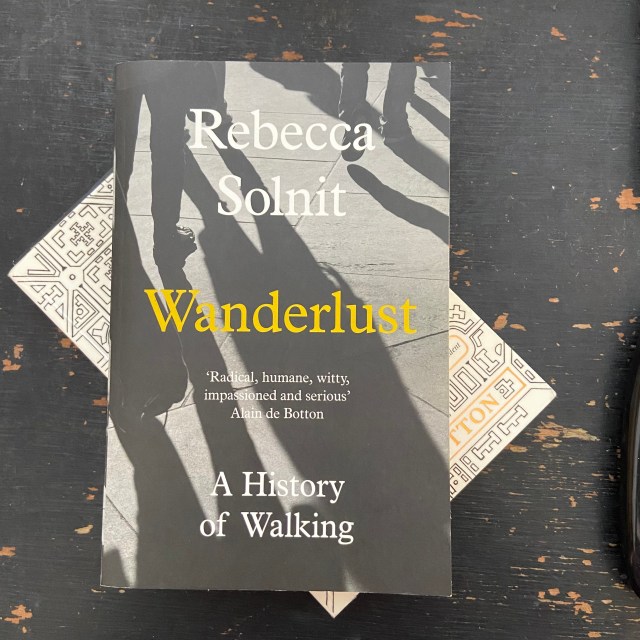
In a recent article for The Guardian, Rebecca Solnit writes about resistance, something that is more important than ever in these terrifying times but in one of my favourite of her books, Wanderlust, she also writes about flaneuring. Flaneurs have been described as ‘loiterers’, ‘fritterers’and ‘primeval slackers’ and, to paraphrase both Solnit and Baudelaire who she quotes, asphalt botanisers who find enchantment in the streets. All of them though have in common a curiosity about ‘the city as some kind of wilderness, mysterious, dark, dangerous and endlessly interesting.’
Although I encountered no danger or darkness whilst flaneuring in the foyers that I discovered whilst on a recent jaunt into town, there was plenty of enchantment, and much fodder for a philosophy of resistance.
One of my favourite things to do whilst traipsing a city street is to take a twilrl through a set of revolving glass doors and, after several attempts at exiting into the foyer and not back onto the street, find myself in one of these purely functional spaces that are surprisingly often quite beautiful.
But before we meander into our first foyer, lets scrutinize the etymology of this word (fact checking being as essential to the resistance project as a lifejacket is on a boat.) There seems to be a little disagreement about what we should call these part public, part private, in-between spaces. According to Wiki, a foyer is the ‘intermediate area between the exterior and interior of a building, especially a theatre. The name is also applied rather indiscriminately to lobbies of public buildings.’
Okay, so perhaps I wasn’t flaneuring in foyers but simply loitering in lobbies.
In the spirit of resistance, I continued to google. According to Squeegee Squad, experts in the design of building lobbies, a lobby is ‘the first thing people see when entering a building. It may also be referred to as a foyer or entryway.’ Phew.
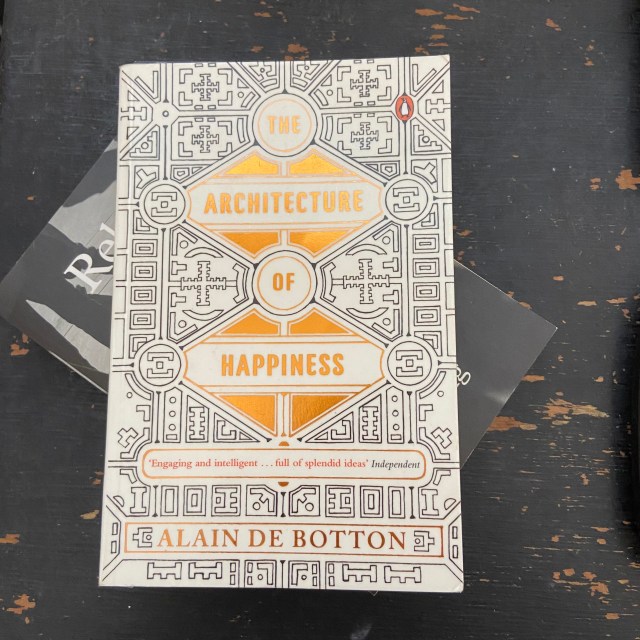
But then I decided I should consult more than Wiki for my information because the internet is making us both dumber and smarter at the same time. So, I borrowed an excellent book from the library, The Architecture of Happiness by Alain De Botton. Now I felt confident that when asking difficult questions about foyers, I would get appropriately complex answers not just an AI deep sea trawl of a billion websites. After all, simplicity is the enemy of democracy and the whole point of resistance is to protect that frangible concept.
Although Botton didn’t spend anytime defining foyers in his 270 page tome, he was nonetheless helpful, reminding me that buildings speak to us of what we think is important, they ‘prompt a state of the soul’. And so, I will try to explain what these three foyers within a kilometre of each other in Sydney’s CBD, said to me.

The first foyer was at 350 George Street, abutting Angel Place, one of those grand Romanesque granite buildings that makes this end of Sydney’s premier boulevarde, with its nouveau wall of high-end boutiques, feel like 5th Avenue. It was designed by American architect Edward Raht and constructed in the early 1890’s. Although it’s been around for a lot longer, I have ignored this building my whole life and only happened on its foyer on this day because I wanted to avoid someone’s footpath coughing fit (yes, a Barnacle like remnant of COVID paranoia).
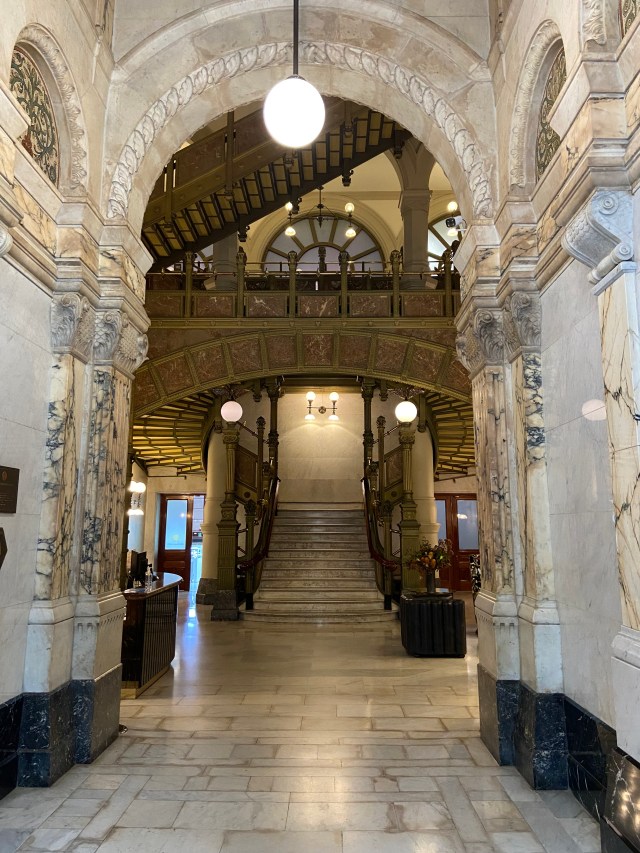
Who knew there was such splendour behind the boring old stone façade? All marble and gilded wooden bannisters ascending operatic staircases. It’s the ultimate in Baroque Revival. I imagine it was built to reflect the wealth and excitement that would have flowed through the streets of Sydney at the very end of the nineteenth century and just before the Australian colonies federated into a squeaky new nation. Women didn’t yet have the vote in 1895 when it was built but one of the building’s tenants, suffragist Maybanke Wolstenholme, ran her newspapers, Woman’s Voice and Women’s Federation League from offices in the building. Her and her sister suffragettes’ acts of small and large resistance over several decades resulted in Australian women winning the vote in 1902. I imagine Maybanke turning up each day (persistence being essential to democratic progress) and being inspired to continue by this courageous fake it till you make it foyer.

Barangaroo is a new place to hang in an old city. It faces west so requires courage to visit on a summer afternoon but is a shady waterside destination in the mornings. I can recommend the coffee in the foyer of Number 3, International Towers at Exchange Place which was completed in 2016 and designed by Richard Rogers and Ivan Harbour. Kinda cute considering the building is on the eastren edge of Darling Harbour.
I’m a big fan of the important trend of foyers with their very own coffee shop. Although this foyer takes care of the quotidian needs of its inhabitants, it also speaks of the opulent aspirations of the 21st century. Sky soaring walls the deep blue of a glittering ocean and chandeliers that drop from unfathomable heights suggest wealth with a sleek contemporary tone. Built to reflect the virtues of order and balance and to inspire human endeavour through beauty, it’s a wonderful welcome for your work force.

And then there are the panels over the entrances that evoke the Australian bush at sunrise and sunset, harking back to medieval stained-glass windows. And reminding us that each day is a new start but will also finally end. A perfect accompaniment for the 9 to 5 rhythm of an office building.
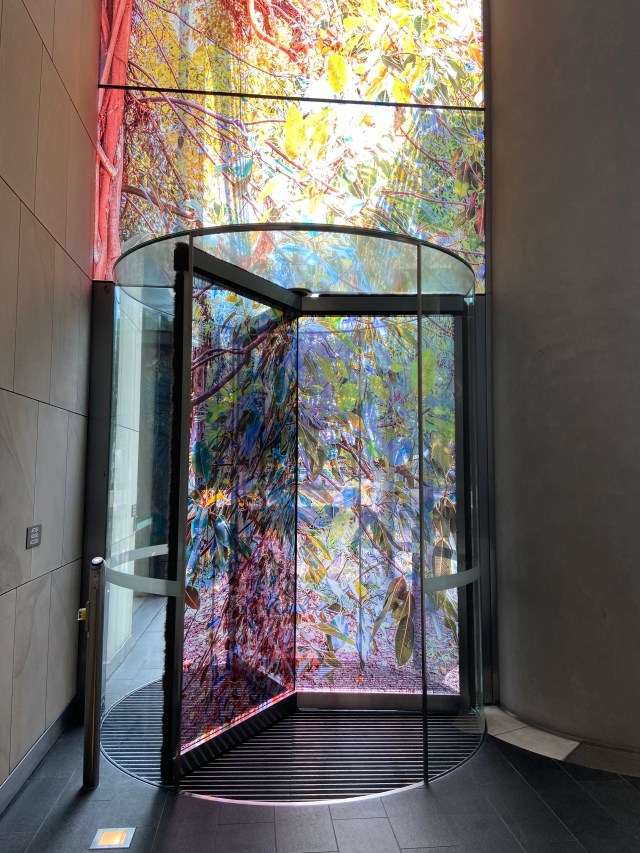
But those panels are subversive too: hinting at, reminding us, admonishing even, with visions of what (and who) was here before the skyscraper city that superseded the original landscape. I cannot imagine such a message being allowed in a building in Hitler’s Germany for example – there the purpose of design was to speak always of impregnable power. Only in a democracy can the soft underbelly of our society be revealed in the everyday of architecture.
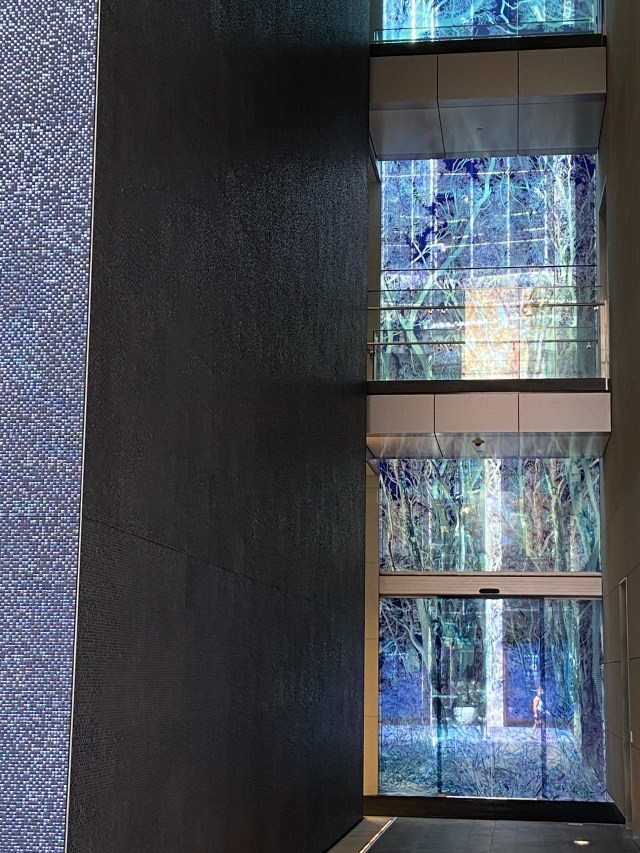 On the weekday morning in mid-January that I stepped into this foyer it was filled with crisp suits and pretty office dresses which easily matched the beauty of the space. I was carrying out my own small acts of resistance by not wearing either of these uniforms, and feeling fine about not spending my day toiling in the heights of this great tower. But I was not going to resist the nutty caramel smell coming out of the coffee machine.
As I waited in line for what turned out to be very good coffee, the mood was reminiscent of the first day back at school after a long summer break. Before social media that is, when the only people you’d spoken to for six weeks were your family. No doubt the energy in this foyer varies with the seasons. So, it’s a perfect place to nip out to when the office drama just all gets too much.
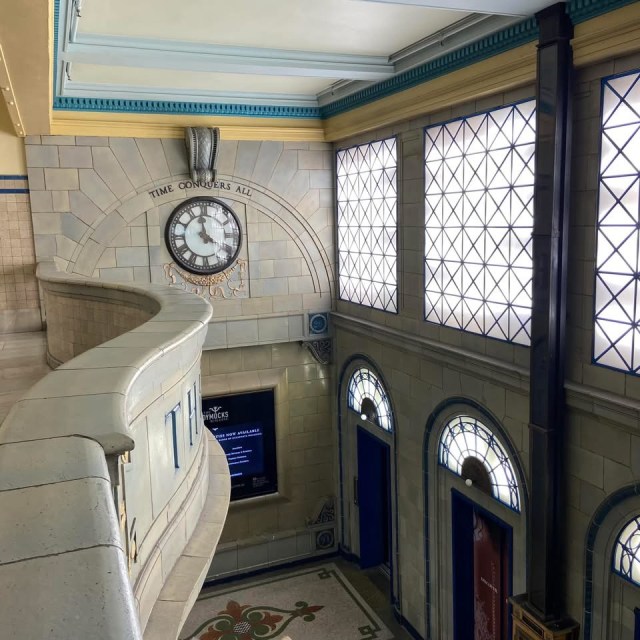
A little while later and back on George Street, I popped into one of my favourite city foyers in the Dymock’s building. This is a platform nine and three quarters sort of foyer whose decorative symmetry in the 1920s Commercial Palazzo Style is an adventure in its own right – but it’s also the portal to nine galleries – whole floors of exquisite little shops (including beauticians, dressmakers, goldsmiths and purveyors of vinyl records, devotional goods and fishing equipment). The whole shebang was designed by architect F. H. B. Wilton. It’s further testament to the failings of the internet that I cannot discover anywhere online Mr Wilton’s given names. But then a bad carpenter always blames her tools. After all, for most of my life I didn’t know this place was even here but that doesn’t mean it didn’t exist.
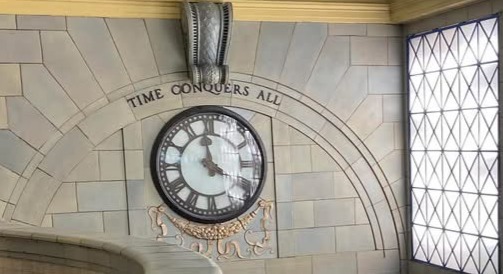
I now regularly drop into this foyer, usually after reading the morning news, and not because there is a coffee shop – it’s in the second-floor loft of the adjacent Dymock’s Bookstore and is also highly recommended – but because I need to re-read the inscription above the Roman numeral clock that hangs wisely in the foyer.
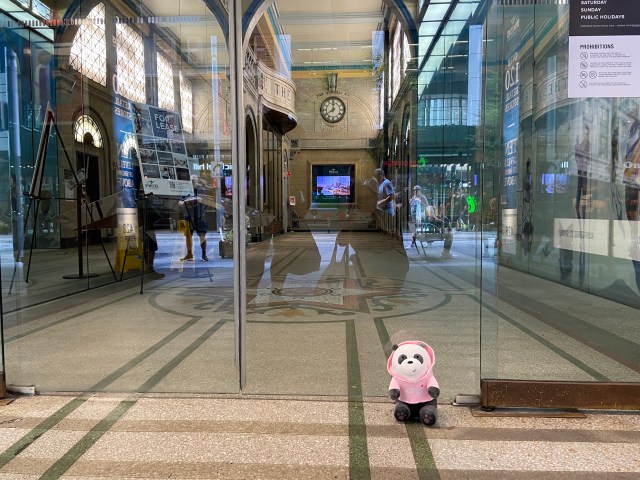
For modern flaneurs, foyers are perfect for accidental expeditions neatly fitted in between acts of resistance. In fact, one might say this sort of subversive time wasting is itself a form of resistance, especially if you add in animal plushies, emulating the tactics of those 20th century Eastern European activists who strategically placed stuffed toys in public places as a protest against the draining dourness of totalitarianism.
Foyers are a combination of tiny art gallery (the poetry of architecture) and weird escape room (the promise of architecture). However, when the flaneur leaves the foyer, the bright light of reality awaits. Luckily, the great foyers are within salivating distance of an excellent coffee shop (I argue that this is intrinsic to its greatness as a foyer) complete with scrumptious cake selection. I’ll have to hop onto Wiki to amend their definition of the word foyer to include this important element.
Returning to idea of cultivating a philosophy of resistance: in her article, Solnit suggests that fighting for justice doesn’t have to be a big dramatic act. It can be small. And it can be accompanied by cake. This bit was not suggested in Solnit’s article but then she’s a little closer to the action at the moment where levity is harder to emote. From the safer distance of the Antipodes, I will suggest that amongst our acts of resistance we should include eating cake but also paying attention; being silly but also asking difficult questions; encouraging complexity but also delighting in simplicity. Walking, talking, joining, dissenting, subverting and let’s not forget laughing. After all, the popular 19th century tradition of duelling to restore one’s honour was laughed out of fashion by a new generation that thought it the most ridiculous way to resolve a dispute.
So, the next time you pass an unknown foyer, step into the wilderness and enjoy the mystery, taking a moment to resist autocracy and regroup in the endless fight against oppression.


 sage somethymes
There are so many hidden gems around town and you’ve stumbled across something. Absolutely stunning, love it.
Foyer, entryway, vestibule, mudroom. So many ways to describe it. But thanks to Google there may be some clarity, maybe 😂
“As they were traditionally used, a foyer was a formal welcoming space to greet guests into a home, while a vestibule was most commonly a less formal entrance space used only by the occupants of the home. These days, a vestibule is more closely compared to a mudroom.
A mudroom is a small room or entryway where footwear and outer clothes can be removed before entering a house.
“shoes don’t come into the house—they are removed and stashed away in the mudroom””