A Time For Every Purpose

I like to wash the dishes late at night after everyone has gone to bed. Occasionally I hear a gruffle in the darkness outside my kitchen window. And when later I fall asleep, I dream of possums chasing each other up and down Jacaranda trees. In the morning, as the kettle whistles, I admire the shiny clean sculpture on the dish rack.

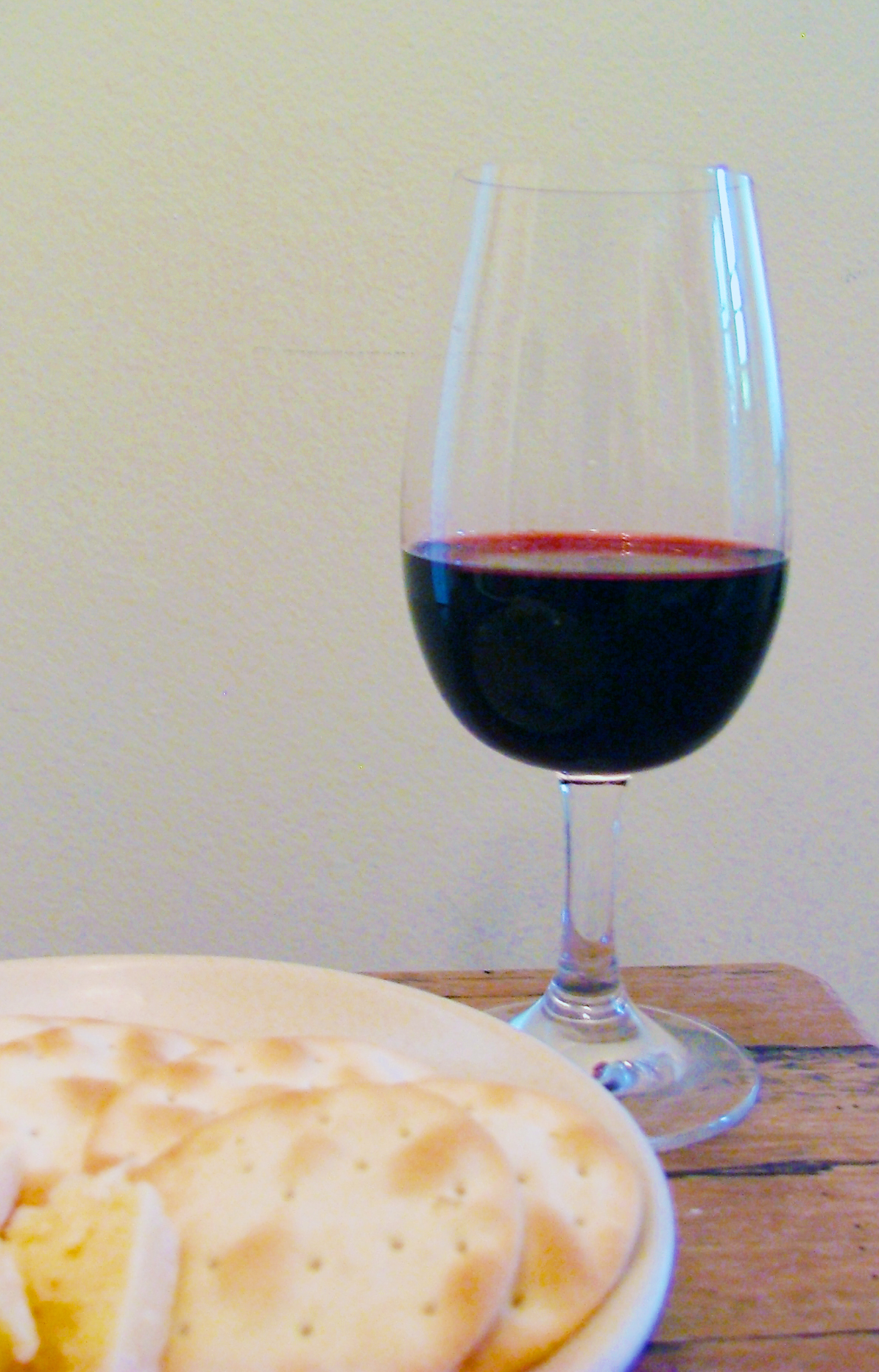
I like to write at dusk with the Currawongs gathered in choirs along the branches of my neighbour’s scribbly gum. Their curlicue calls symphony with the chatter of parrots on the wires, while below them the local cats wait for dinner.  Surrounded by night approaching, the sky and the birds are squawking, and fading pink. That’s when, with a glass of red wine beside me and the day behind me, the vegetables peeled and the roast in the oven, time is corralled; and ideas appear on the page, landing softly with invisible paws.

And I like to take my daily walk at noon.  In these first days of November I circle the meditative loop of Centennial Park under the midday sun and time and place melt away as the heat begins to strike.

I’m prepared. I’ve smeared my arms and legs with sun block. I’ve turned up my collar and pulled on my hat.  I am determined to enjoy this slow sauna while I think about what to make for dinner. But it’s hotter than I expected, and by the time I reach the first bubbler at the quarter mile, I feel like the chicken that I’ve been imagining roasting in the oven.

I’ve been basted with olive oil, an aroma of rosemary and garlic emanates from my pores, and my white socks remind me of those frilly little paper chef hats that my mother used to put on the chicken legs to cover their knobby knees.

After forty minutes on the rotisserie I collapse in the shade of a Moreton Bay Fig. I rest for about twenty minutes or until my skin loses its pink hue. It’s important at this stage not to hurry. I meditate on the lost art of patience.

This I’ve found is the most difficult part of any roast: waiting while the meat rests. It’s so tempting to carve it then and there, and wolf it down over the sink. But although there is delight in raw abandon I prefer the sustaining pleasure of savouring time.

You take the chicken out of the oven, place it on a rack and cover it with foil. That’s when you make the gravy from those precious brown juices that have gathered at the bottom of the roasting pan. And by the time you set the table and refill that glass of wine you’ve no doubt been drinking, the bird is ready to be pulled apart, hopefully in the company of friends; it’s soft, tender flesh literally falling off the bone.
Posted in The Animal Kingdom, Time | Leave a comment

Wallah!

Tomatoes are the rabbits of the lunch world. They can be pulled out of your hat and added to just about anything found in the bottom of the fridge and, wallah, lunch!  In this case an exotic lunch, a kind of tapas. As you probably know, tapas originated in Spain, and is a selection of small dishes drunk with wine.

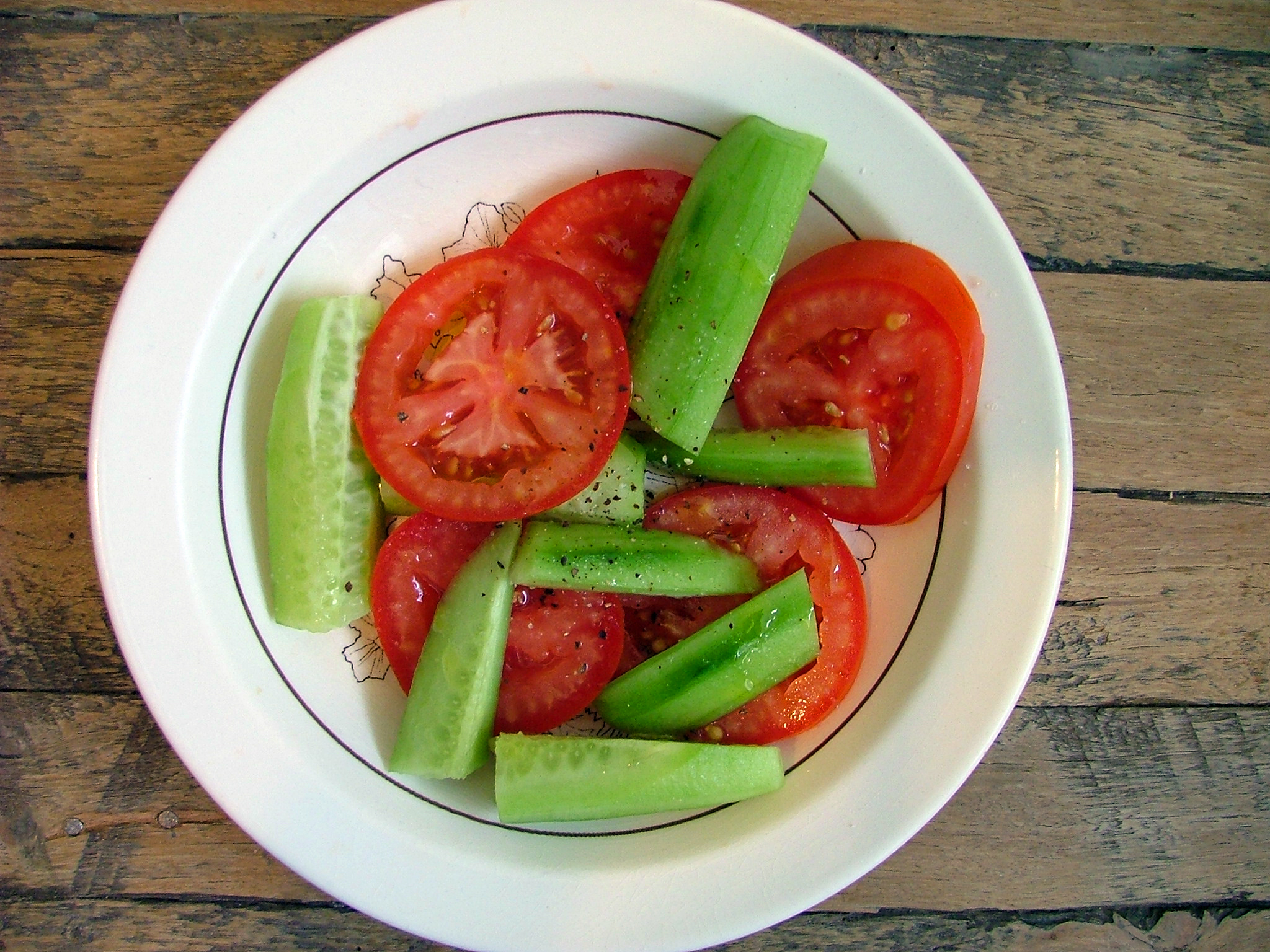
Tapas Dish No 1 consisted of a couple of tomatoes, bought at our local farmers’ market; the first of the season, warm and red and ripe, sliced into discs. Beside them on the plate I laid the cucumber that had escaped yesterday’s salad. I like my cucumbers sliced lengthways.  A sprinkling of salt and pepper, a splash of olive oil. Wallah!

Then I took out of the crisper the half a packet of baby spinach leftover from a wave of guilt. I’ve just been informed by my housemate that the bottom of the fridge is commonly called the crisper.  I popped the spinach into the microwave for a full three minutes. It wilted even more dramatically; the ‘crisper’ hadn’t exactly lived up to its reputation.  But, with the addition of a microwave, a little salt and pepper and a splash of olive oil, wallah! Tapas Dish No 2.

Now I don’t believe that you can call a meal tapas if it consists of less than three dishes. Then it’s just spoiling your appetite.

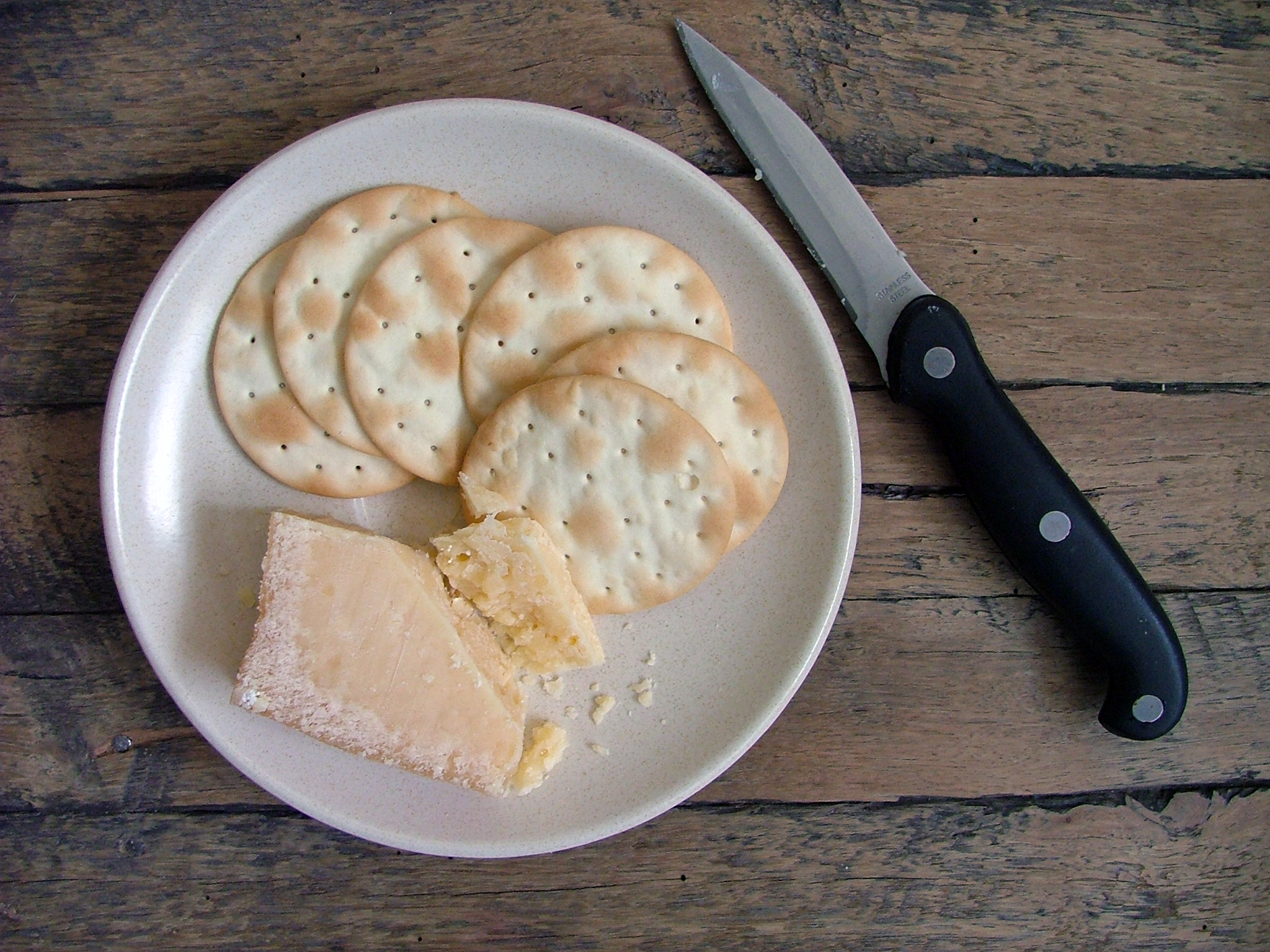
So I decided to break open the box of water crackers, usually reserved for guests and a dip, and laid six of them on a dish. If you are wondering why six; it’s a serving, according to the instructions on the box. It’s knowing this kind of guidance is available at my fingertips that gives me the confidence to experiment in the kitchen.

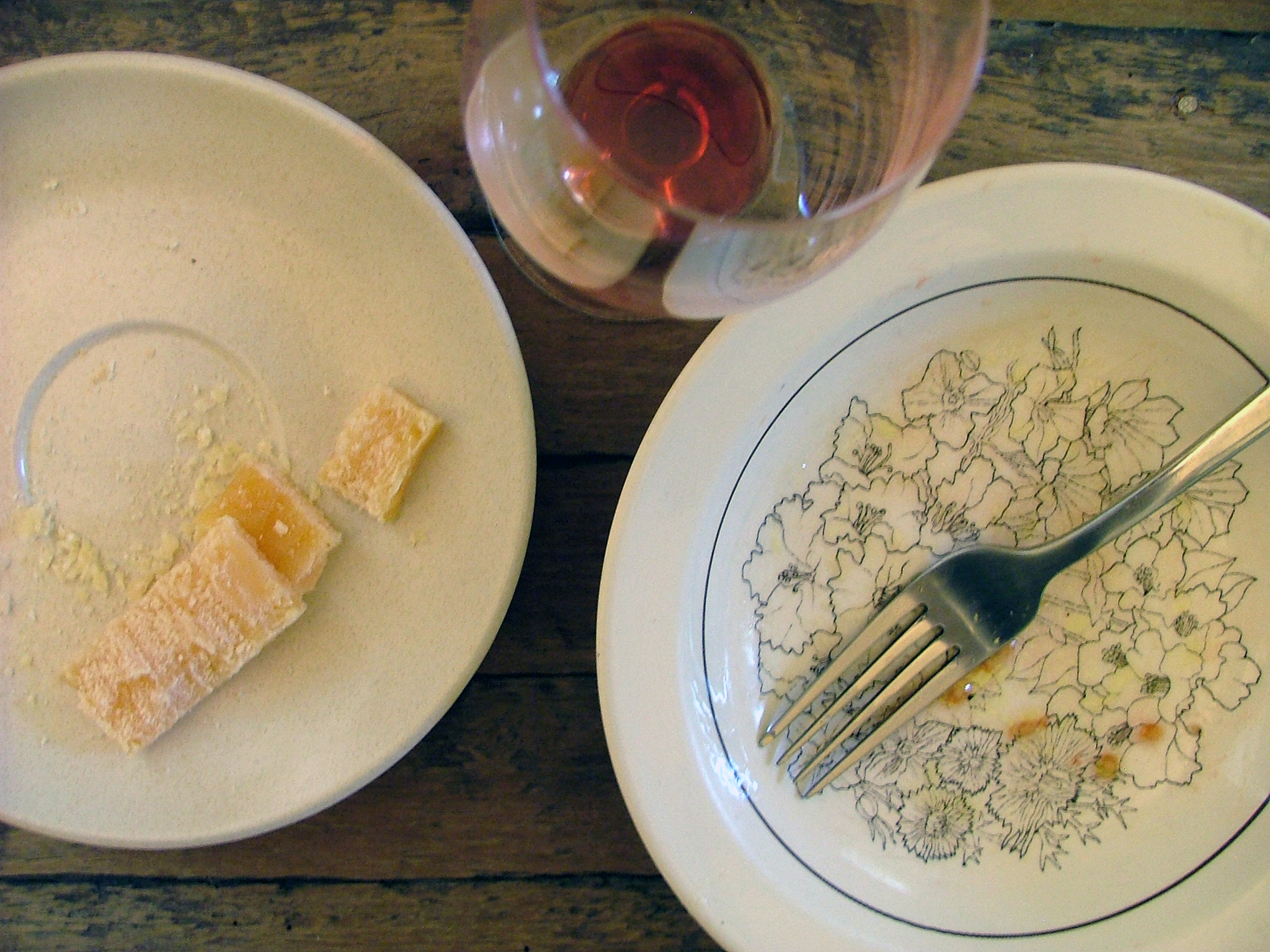
To accompany the crackers I took, from the place in the back of the fridge where I had carefully secreted it, the block of parmesan that is usually reserved for pasta. A certain amount of subterfuge is required when it comes to storing parmesan, because there are people who believe that parmesan can be eaten at any time. These people are in the habit of crumbling rather large chunks of this expensive killer onto a plate and eating it, with or without guest crackers. But today, in the name of tapas, it was I who crumbled rather large chunks of parmesan onto a plate. And wallah! Tapas Dish No 3.

Note: As of going to print, no proper name for the place that I hide the parmesan, has been volunteered. Interesting that the bottom of the fridge is the ‘crisper’ but the back of the fridge, is just the ‘back of the fridge’?

I set the table: a simple place mat, a fork, a napkin and my three little dishes.  But there was something missing. And then I remembered the derivation of the word tapas, from the Spanish for ‘covering.’ Ask any old Andalusian and they’ll tell you that when sitting in a tavern in summer, warding off the heat with a sticky sherry, you have to cover your glass with pieces of bread or meat to keep away the flies.

Fortunately, there was  no sherry in the house, so I poured myself a glass of wine. The wine was already open. We had quaffed it with our spag bog the night before. A day of airing had not improved its taste. Mental note: keep a store of wet cardboard as an alternative.

It was a 2002 Shiraz from the Barossa.  Yes, a 12 year old wine. The label suggested that it would be at its best at 10 years. What a pity I hadn’t walked into the bottle shop two years ago. But then it probably wouldn’t have been in the specials bin.

I’m one of those people that love the specials bin. It’s like being a kid at the lucky dip. You close your eyes, stick your hand in and pull out treasure, even though everybody else pulls out some product of child labour. Perhaps if I had kept my eyes open and actually looked at the label, I might then have also noticed the cork. But then again, I haven’t seen a bottle of wine with a cork for about ten years, so the chances of recognising it were always going to be slim.

So as I mixed the bog into the spag my housemate said, “It’s a cork! Do we even have a corkscrew?” And the adventures began.  You’ve probably had this dilemma yourself. You search the cutlery drawer, an obvious place. Then you rummage through the utensils, check the pantry, buttery and larder; nothing. You run out to the car to check the glove box, in vain.  You wonder what your chances of finding a neighbour with a cork screw actually are. Finally you remember your ruck sack from uni, which you’ve been meaning to take to the op shop. You climb into the attic, and judging by the level of exertion required, and the amount of dust inhaled, it’s been a lot longer than ten years since you’ve seen a bottle with a cork.  With the equivalent effort of diving to the bottom of Marianas Trench, you recover the bag. And surfacing through the flotsam and jetsam of a thousand forgotten days, wallah!  A corkscrew.  And the cork is released from the bottle with that sigh that only a cork coming out of a bottle can make.

So I poured myself a glass of last night’s wine and  settled down to my tapas lunch; stealing a few moments out of my own sticky day to toast those old Andalusians for their ingenuity.

Posted in Experiments with Food, Time | Leave a comment

A Place at the Table

A Place at the Table

Posted in The Sages | Leave a comment

Little Italy in Liverpool

This is no pomegranates and cinnamon memoir.

My childhood memories of food are all about broccoli sandwiches, tripe in tomato sauce and home slaughtered chicken. At play lunch I longed for the simplicity of a Vegemite sandwich but had to make do with broccoli on bread.

My first day at school in Australia was in 1978. I was in the 3rd grade.  I sat in the playground watching in fascination as out of crisp, brown paper bags, came neat, white sandwich triangles, crust removed, held together by a filmy plastic wrap, the likes of which I’d never seen before. After a tug of war between my stomach and excruciating embarrassment, my stomach won, and I took a tea towel from my bag and unwrapped a large, cold Calzone stuffed with olives, anchovies and salami. Last night’s leftovers for lunch. Around me, eight year old jaws dropped to their knee high white socks. But only for a second. Wits gathered, a chorus of “Yuck! Wog food!” bellowed at me.

Is it any wonder then, that as an adult I have difficulty making anything harder than a reservation for dinner?

Just the act of planning a home cooked meal releases memories that have me scurrying out of the house, and into the nearest restaurant. The mere mention of chicken, for example, catapults me back in time. I am standing in horror watching my mother systematically break the necks of each of our five backyard chooks.  Up to that moment, I had thought of them as pets. Fluffy, Silky, Chuckles, Betty and Lolly. But after seeing their headless bodies dunked in boiling water, feathers plucked, and the remaining carcasses gutted, I realised they were soup.

My father only cooked once a month, which for most men of his age and background, would have been once a month too often. He worked in the building industry and on his rostered days off he’d don an apron and spend hours in the kitchen creating his signature dish – slow cooked tripe.  I would smell it as soon as I walked into the house after school. And on those days I was delighted that I didn’t have any friends to invite over.

But now in my forties, I’m overcoming my cultural kitchen cringe.

I’m fascinated by my sixty eight year old mother’s ability to pursue the eating habits of the Italian peasantry whilst living in a Sydney suburb. On any given visit to her house I catalogue the variety of food she has sourced locally (read here – foraged, gleaned, bartered, or simply been in the right place at the right time for): kid goat, quails, broad beans, spinach, tomatoes, eggplant, broccoli, fresh ricotta, eggs, lemons and the list goes on.  I’m not as enthusiastic however when she mentions that she’s gone mushroom gathering with friends in the forests near Oberon, but I happily eat the apples, picked at farm stops on her way home through the Hawkesbury. I also leave happily loaded down with jars of tomato passata, tubs of frozen minestrone and anything else that I find in her pantry.

This ambivalent food heritage, and the challenge to reduce my ecological footprint, has inspired a quest to develop more sustainable food habits.  I don’t think I’m alone in this.

The recent interest in fresh, organic food, sourced from close to home, or from sources that promote fair trade, as well as the development of sustainable farming practices, is part of a civic renaissance in our political and social cultures.  I think these can help us to tackle climate change and the world food crisis. Yes, my glass is half full. Each day, through the choices we make about food and about how we spend our time, we create our culture.

And so, taking this as my manifesto, I will finally learn to cook, but I’ll also gratefully accept my mother’s (and anyone else’s) generosity, and eat whatever I’m given. Except for tripe.


Posted in Experiments with Food, My Mother and Me, Time | 1 Comment

Home Made Yoghurt or Kitchen Elves

Have you noticed the growing trend to make your own yoghurt? Gourmet writing circles are awash with this craze. Personally, I think it’s an obsession with cheating the system; a belief that something can be had for nothing.

You think: Why am I buying this slop at the supermarket in these tiny tubs with the not so tiny price? Isn’t it just a whole lot of bacteria and milk? Aren’t bacteria everywhere? Doesn’t milk just come out of the fridge?

There must be a way to make yoghurt out of nothing.  Do you see the drift here?

Not to mention, that commercial yoghurt comes in plastic tubs that need recycling, and we don’t need to encourage the making of any more plastic tubs on our planet, even if we are recycling them. What is all that recycled petroleum product being used for anyway?

Do you see how the moral justifications for cheating evolve into a philosophy?

So you do your research, and you find out, that the best way to make yoghurt is to use a yoghurt machine. So you buy this yoghurt making appliance, which seems to be just a very big thermos, and costs the same as six month’s supply of yoghurt.  But never mind, you will save money in the long run, well in seven months.

Except that each time you make the yoghurt, you have to buy the packet of powdered yoghurt culture from the supermarket, specifically made and sold for the appliance you have just bought. Never mind, this is a small investment for a life time of healthy living, helping the planet and independence from the commercial machine.

And so you follow the instructions, and miraculously you make a very nice 1kg container of yoghurt. It works! But that leads to some questioning. What after all have you achieved? You’ve replaced one commercial product with another. You haven’t actually by-passed the system at all. You’re not exactly living in a state of total self sufficiency.

So you decide to by-pass the yoghurt maker.

You follow a recipe from the internet.

Mix a few spoonfuls of yoghurt with 500ml of boiled milk, add 1 tablespoon powdered milk. Pop the mixture into a large glass jar, swaddling the whole thing in a lot of tea towels, and keep in a warm oven overnight.

You follow the recipe exactly, except that you don’t use any powdered milk. You were unwilling to pay the six dollars for the kilo of powdered milk available at the supermarket. And you were unable to forage any from your mother’s pantry. So you swaddle your mixture in a mountain of tea towels and place it in the oven. Then you go to bed.

It’s surprising that you can get to sleep with the miracle that’s occurring in your kitchen, but somehow you do. In the morning, you check the yoghurt in the oven. Except that it’s not yoghurt. It is a jar of thin, bilish, yellow liquid, with white lumps at the bottom.

Perhaps you’ve learnt your lesson and will return to the ease of shop bought yoghurt.

But then you hear about the offspring of yoghurt, yoghurt cheese or Labneh. It too is quite trendy at the moment. Apparently you just dump a whole lot of yoghurt into a sieve, which is lined with cheese cloth, and let it drain overnight.

There are two mysteries here. The first is cheesecloth. Need I say more?

And the second mystery is the overnight concept.

The yoghurt failure has made you quite suspicious of the overnight concept. These people must have kitchen elves. The elves that came with your kitchen are lazy elves. Who knows what they’re up to, when they should be magically transforming nothing into food.

So you borrow a video camera from a friend and set it up in the kitchen overnight.

Why not just pop into the kitchen yourself in the middle of the night, and catch them in person? Because everyone knows that elves don’t show themselves to humans.

And because the last time you wandered into the kitchen, in the early hours of the morning, for a glass of milk, and some of the delicious home made biscuits that you did forage from your mother’s pantry, you found a large furry friend, foraging.

Ahh, the joys of self sufficiency in the city.

Posted in Experiments with Food, The Animal Kingdom | Leave a comment

Yoga Soup

In Sanskrit, the word yoga means the union of the universal soul with the individual spirit. For me it is an essential part of my spiritual practice and balances my physical and mental well being. And so it helps to have discovered the most amazing Yoga teacher.

Her name is Lynda and her studio is on my list of top ten indoor spaces in Australia. Yes I have several of these lists: top ten built spaces; top ten gardens; top ten parks; top ten bookshops etc. Making lists is a great way to while away some time at the bus stop, or while waiting for the rain to stop, or the muse to return.

Every Tuesday evening I walk down the hill to Lynda’s yoga studio which overlooks the park. The class is a series of postures, breathing and meditation. And if you’re not in a hurry, she’ll crack your back, and give you a good twist at the end. Usually she’ll also have an interesting tea, which has brewed during the class; she pours it for us from her gorgeous Chinese pot into tiny tea cups. There might be liquorice, mandarin or cherry infusions; cinnamon, ginger or peppermint concoctions; or a spicy chai. Each week is a surprise. It’s like no other yoga class I’ve ever been to; such beautiful hospitality is truly the sign of a generous soul. We stand around drinking our tea, and chatting in the semi-darkness, and it is conviviality itself.

And as I walk home, detouring via the beach, to look at the yachts swaying in the bay, their masts playing like percussion instruments, I am energised once more. Lynda has worked her weekly miracle.

Well the other night, it was as usual, a restorative and stimulating yoga session. But at the end, there was no tea. So I prepared to head out into the cold and dark, chin up, and grateful that there had ever been any tea. After all, it’s not like I don’t have my own tea at home.

And then I heard Lynda say, “Tonight I’ve made soup for you all.”

I couldn’t believe what I’d heard, but the nose doesn’t lie. A  sweet, tantalizing aroma was wafting through the room. Into little white cups, Lynda ladled her own-made sweet potato and coriander soup. And it didn’t stop there. The next week she treated us to curried capsicum soup. And this week, to the most beautiful Borscht; beetroot, potato, onion, parsley and sour cream. And the secret ingredient – vodka! Apparently, it’s the trick to getting just the right smoothness.

Now I don’t just say this because my inner child loves to get such treats, Lynda is not just a great yoga teacher, she is an inspiration; a role model for how to live.

And so tonight, in the spirit of reciprocity, I decided to make soup for a friend who is not well. A spiced Moroccan soup, the recipe is below. Perhaps there is someone you know that could do with some soup too.

It’s also made me think I should try my hand in a soup kitchen; not making it, just serving it! There are plenty of people who could do with a soul sustaining soup on these cold winter nights, who aren’t lucky enough to have Lynda as a yoga teacher, or a home to go back to.

Spiced Moroccan Soup

Fry chopped onion and garlic in your soup pot, with ground cumin and coriander.

Grind it from the seeds with a mortar and pestle.

The smell is divine.

Add one cubed sweet potato and two chopped carrots.

Stir for five minutes, then add six cups of chicken stock.

Simmer for twenty minutes, stirring occasionally, then add a can of drained chickpeas.

Simmer for another ten minutes.

Take of the heat and blend in the pot with a potato masher.

Serve with yummy bread.

Posted in Experiments with Food | Leave a comment

Oranges and Memory

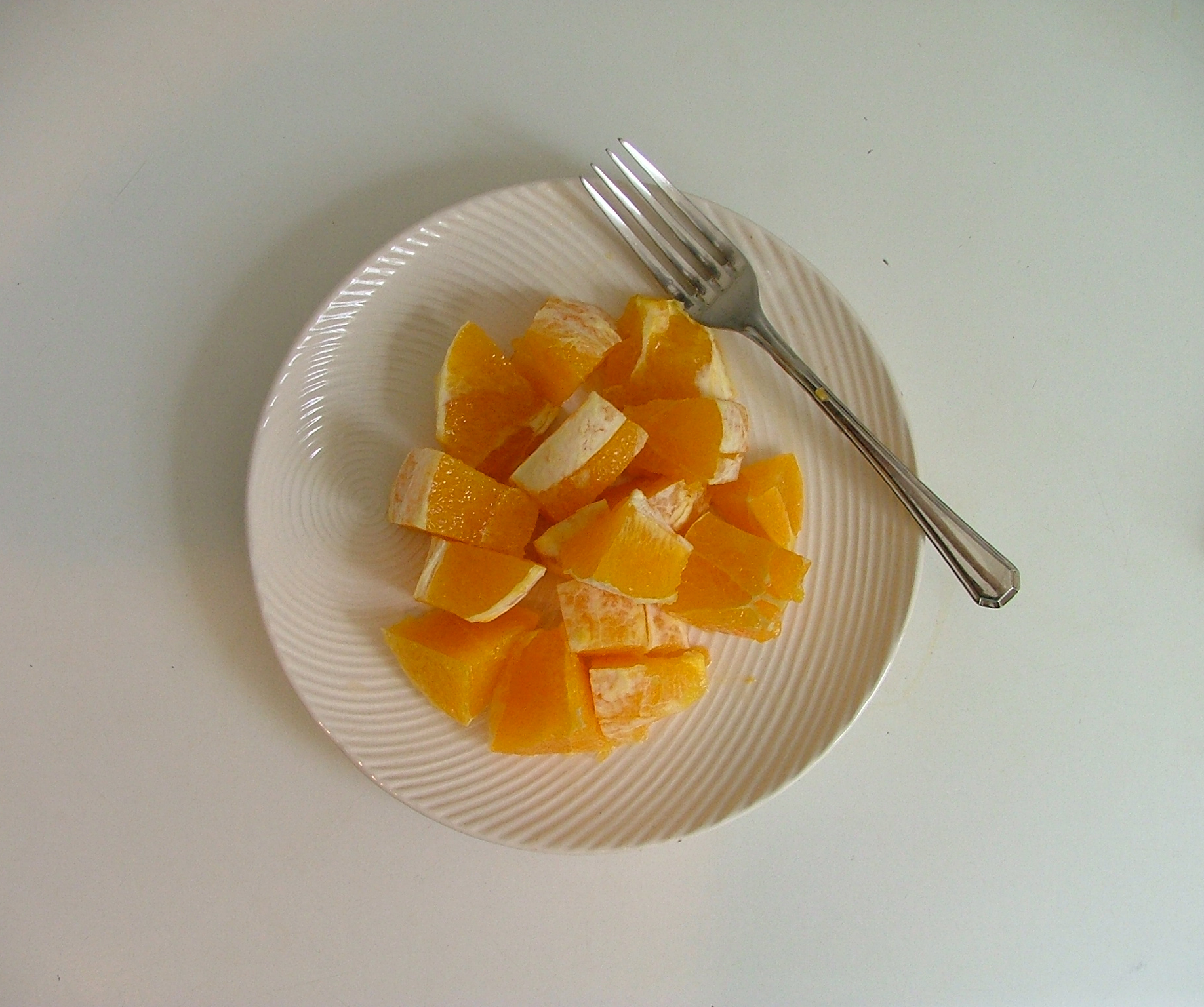
It’s winter and oranges are cheap and sweet.                                                                                                                                                                                        Take out the cutting board and a sharp knife.   Slice off each end of the orange. Cut lines into the skin all the way round.  Peel off each of the sections.  Cut the orange into 2cm cubes. Eat with fingers or a fork.

It’s hard to believe that these little balls of sunshine are winter fruit.

After a week of rain, summer is on my mind. But the solstice has just gone and as the old saying goes: as the days grow longer, the cold gets stronger. And so I eat oranges and wait for the seasons to change and the rain to end. And I populate my mind with words like tenacity, resilience, persistence, patience: winter words. And I like to do winter things, like curl up on the couch and read books; books filled with heroes and heroines that display  the above characteristics.

And I eat oranges, off a plate, with a fork. I like my food cut up neat so that it’s easier to eat. I remember my father cutting oranges up like this for me when I was little. And I remember eating an orange as I read I am David, and being delighted that oranges saved David’s life.

This novel isset in WWII and is about a twelve year old boy who escapes the horrors of a Nazi concentration camp. He travels south through winter for many weeks, to get away. The book ends with his arrival in Southern Italy, where he comes upon a grove of oranges in an orchard covered in snow. He is at the point of starvation and he feasts on the oranges and they sustain him for what lies ahead.

At least that’s how I remember it.

I went to my local library and braved the downstairs children’s section to borrow I am David. It was remarkably clean, as was the children’s library. I had expected it to have years of sticky fingers all over it. And so I sat down on a rainy afternoon with an orange, quite excited about rereading one of my favourite childhood books.

And there the disappointments begin. Not to mention the fear. Not of the Nazi’s, or sticky children’s libraries, but of what else I might remember that is actually nothing like the reality. Let me explain.

As I began reading I realized that not only is the book not set in WWII but David doesn’t escape from a Nazi concentration camp; although he is twelve and there are definitely horrors in the camp. But that’s probably generic to concentration camps. The novel is set in the 1950’s. And it’s communism in Eastern Europe, and some sort of gulag, that he’s escaping from.

And I have no memory whatsoever of the racism and propaganda that the book is littered with. Probably because when you grow up in 1970’s South Africa you can’t afford to think about racism, or propaganda.

For example, David’s aim is to get to a country with a king; because those countries are safe and look after their citizens. And all the Italians that he meets, laugh all the time; but all the Swiss are dour, one of them even locks him up in a barn for the rest of winter. And all the English are serious, but concerned about children wandering around alone, claiming they are travelling north to join the circus. But the worst disappointment of all is the oranges. Yes a starving boy comes upon a grove of oranges in winter in Italy, but where is the snow?

So now I feel compelled to reread all of my other favourite childhood books. I need to find out if Scamper the dog was really fed ice cream by the Secret Seven. And did the children in the Famous Five get given all those cakes and jellies and cream and custard by their mother when they got home from an adventure? Or were they just given admonitions not to fill their tummies with sweets before dinner, like I was. Perhaps my childhood was not so different from that of the little horrors, I mean little heroes, in these stories.

Now that I think about it, maybe Trixie Belden and Nancy Drew just imagined catching criminals and solving mysteries, while actually sitting in their bedrooms doing their homework . After all that’s what I was doing. And as for Little House on the Prairie, maybe if I reread it, I might get over my fixation with the fantasy of a little house on a few acres, where I can have chickens and grow my own food; and just be happy with my life in a little apartment in a city, where I can go to the supermarket and eat in a restaurant.

Hopefully this winter rain will last long enough for me to find out.

Posted in Time | Leave a comment

George Sand’s Herbarium

I am reading George Sand’s Lettres D’Un Voyageur, a birthday gift.  These twelve letters detail not just her physical travels but also her emotional and spiritual journeys. In one letter she instructs a friend on how to dispose of her estate should she encounter death. She leaves all of her worldly goods, which include her books, butterflies and debts as well as a herbarium, to her friends.

What is a herbarium? On looking it up I discover that it is a collection of preserved plant specimens. Perhaps it is something I should consider, not having a backyard, field or patio. Perhaps I can keep a garden between blotting paper or in glass jars.

It’s as if the 19th century is a world even further than we imagine, when I read such eclectic memoirs.

In another letter she writes of the sublime peaks of the Tyrol. She has decided to ‘avoid the squalor of wayside inns…to travel at night when it [is] cold and sleep out of doors in daylight.’ (1)

If only I had had the courage to travel like this when recently visiting South Australia to produce a play at the Adelaide Fringe Festival. Instead I succumbed to the convenience of a cheap motel room.  And night after night of that festival week I lay awake in the March heat unable to sleep. One night, as I lay there, something bit me. I scrambled to put on my bedside lamp. A bug crawled across the sheets. It had drawn blood; mini craters on my arms itched and swelled. On instinct I squashed it between thumbnail and fore finger and my blood splashed red across the sheets.  I spent the rest of the night huddled in the circle of lamplight armed with a thick book, ready to dispatch any other beasts intent on gorging themselves on human blood.  The establishment shall remain unnamed. And Adelaide was otherwise wonderfully welcoming. The fact that I had to dispose of all of my luggage in order to not take the infestation home with me I am determined to see through a glass half full. The whole experience is actually an opportunity – to shop.

So perhaps it is not a herbarium that I will set up but an insect collection complete with glass display case, metal pins and mounting board. And of course labels; bearing the names and address of the inns in which the insects have been discovered. Lettres D’ Infestazion….

(1)     Letter 1, p46

Posted in The Animal Kingdom | Leave a comment

L’orto

There is a food revolution underway in Sydney. Or at least there are regular stories in the newspapers of inner city neighbours collaborating to grow vegies on the nature strips in front of their houses. They remind me of my parents who were born in the south of Italy and as adults migrated, first to South Africa, and then to Australia. My father grew up on a farm but my mother’s family were town people.

As a child my father lived in a village that clung to the foothills of the Apennines to the south of Rome. The village food was farmed on the steep hills outside the ancient gates. The lowlands were reclaimed malarial swamps and the whole area was once the domain of brigands.  Olive trees were planted on the hillsides and basic vegetables were cultivated. Broccoli, artichokes and tomatoes provided seasonal eating. This, according to my father, meant that when artichokes were in season, you ate artichokes; every day, every week, every month of that season.  You ate them boiled, you ate them braised, in pasta, as soup, on bread, by themselves.  You ate them warm, you ate them cold, you ate them until you never wanted to eat them again, and then you preserved them in oil or vinegar, so that you could keep eating them. And once their season was over the ritual would begin again with the next vegetable.  There was always olive oil from the local press and fresh bread from the village oven.  Each household would make their dough twice a week and take it to the oven where it would be baked.  It was my father’s job to pick up the freshly baked bread after school.  He lost count of the number of times that he got the strap for dinner because he had eaten the family’s bread on the way home.

Coincidentally my mother’s family were the bread makers.  They owned and operated the wood fire oven in the Sicilian town that she grew up in.  As a child it was my mother’s job to deliver the bread and collect payment.  She also collected a bonus, usually freshly poached produce from the farms or gardens of the houses she’d just delivered to.  These figs, eggplants and blood oranges supplemented the family diet.  She learnt to be a quick runner and to avoid the physical and verbal abuse that came with being caught.

These stories were told me as I watched my parents tend the veggie patch that they insisted on cultivating in the backyard.  L’Orto. I have only recently excavated this word from my memory. Every house in Australia that my parents have lived in has had a corner of the backyard, complete with compost heap, for growing vegetables. As children we insisted on calling it the veggie patch; hoping that the anglicized words would also anglicize my parents. When I say the word now it connotates dark earth and spring time fertility, but as a child, that corner of the back yard brought me out in a sweaty shame, particularly when school friends visited and saw my parents happily wallowing in this patch of dirt.  It was the ultimate evidence that we were different. We were peasants. Worse still we were wogs.

We didn’t get all of our veggies from the back yard patch though. Some were gleaned from the properties of the market gardeners my parents befriended at the local Italian club; the remnants of recent harvests, the fruits and vegetables that had been missed by the machine harvesters.

Our other food staple was fresh chicory served steamed and drizzled with olive oil. When driving my father would sometimes pull to the side of the road and leap out in great excitement and I knew that Chicory had been spotted. After grabbing plastic bags from the stash kept in the boot for just such occasions, the scouring of the grass verge would begin. Doubled over he and my mother would pick frantically until the area had been stripped of any nutritional value. In Australia chicory is a green that grows wild by the roadside. It has historically been used as stock feed for foraging cattle during times of drought and more recently for relieving symptoms of homesickness in Italian migrants.

So now when I read about homegrown veggies I celebrate what were once the painful memories of an alienated childhood. In the lucky country the wheel of time makes citizens of us all.


Posted in Experiments with Food, My Mother and Me, Uncategorized | 1 Comment

Lemon and Honey

Boil the kettle.                                                                                                                                   Place a spoon of honey into a mug.                                                                                                 Cut a lemon in half and squeeze out every drop of juice.                                                              (I recommend this for life too.)                                                                                                           Pour in the boiling water and stir briskly.                                                                                      Let it cool slightly before drinking.

This is lemon and honey. I can’t rave enough about its healing properties. I dose myself with this brew morning and evening whenever a cold appears on the horizon. The recipe was given to me by a colleague when I had bronchitis and I am very grateful for it.

I’ve since dosed entire casts of productions through flu infested runs in cold and draughty theatres. Winter is a hard time to be an actor. And it’s the worst season to produce theatre, except for every other season. It’s an acquired taste; art, remade each night, before your eyes, in a small black box.

So as well as killing a cold or flu, lemon and honey does wonders for morale, giving us the strength of character to face with equanimity both the empty seats of a cold Wednesday night and the full house on a lively Friday night.  I’ve found it’s particularly efficacious if someone makes it for you.  When a friend, lover, mother or stage manager, brings you a steaming mug of lemon and honey as you bravely prepare, despite being sick, to face the audience.

Now don’t get me wrong, I am not usually an advocate of ‘soldiering on’. Absolutely not. I believe in rest, rest and more rest as the cure for almost anything. The power of sleep. The healing properties of a day in bed, especially if there’s nothing wrong with you. And the wonder of an afternoon nap.  But sometimes the show just must go on. And that’s when this potion works its restorative magic so you can keep squeezing every drop from the lemon.

Posted in Experiments with Food, The Sages | Tagged | Leave a comment