I’m going on a memory walk, retracing the path from Redfern Station to Sydney University that I traipsed daily as a student over thirty years ago. I’m in the mood for a little time travel.
Walking along the narrow footpath on Lawson Street, surrounded by university students, I instantly feel younger. But as I turn left at Abercrombie Street I can see that things have changed. There are a couple of busy coffee shops, a dry cleaner and a hairdresser. People dawdle in smiling groups, sipping coffee from takeaway cups, laughing and slapping each other on the back. All this bonhomie instantly makes me feel older. I think back to the late 1980s when to find a coffee you had to drive to one of the faux-elegant, migrant owned establishments, like George’s Cafe in Newtown or Cosmopolitan’s at Double Bay. This is where you met up with friends and talked late into the night. And ate enormous slices of carrot cake or lemon meringue. Coffee was a special occasion. You didn’t just grab a cup and sip it on the sidewalk while talking to friends on the way to uni. In fact, friends were a special occassion. Now everyone seems to have hundreds of them. But back then Darlington was no place to hang around. Most of the shop fronts on the street were curtained private residences or hidden behind grey roller shutters. There was one dark little takeaway shop but it didn’t sell coffee. And no one ever bought the food. The only reason you’d step inside was to find primary evidence of the deep past for your History assignment.
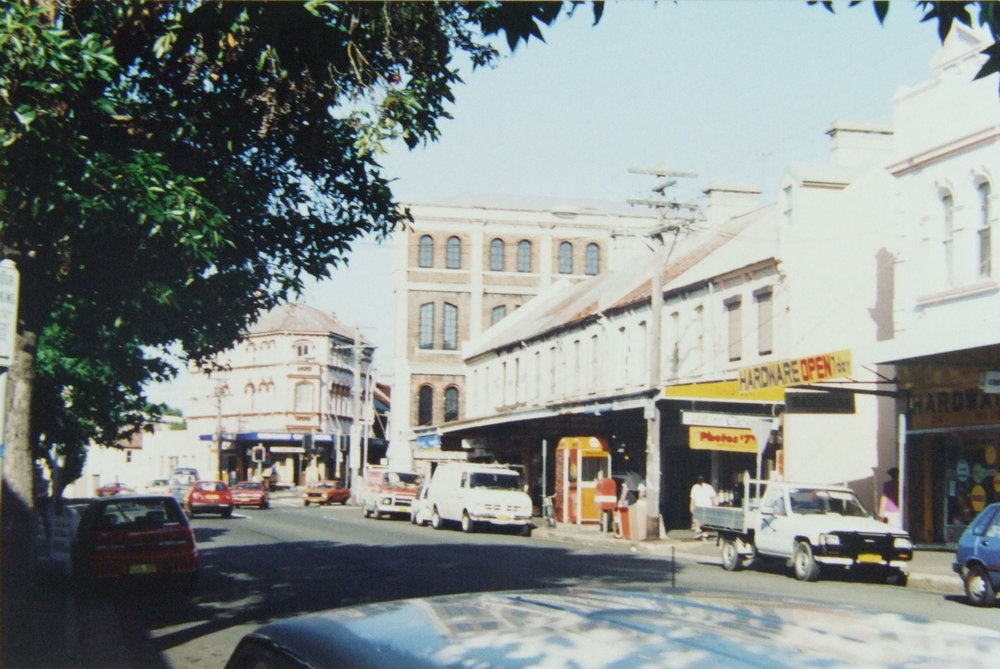
Past the coffee shops and terraces, I stand at the spot that used to be a pedestrian crossing but is now a speed hump. Then, as now, hundreds of students walked this way each day. Mounted police coordinated the crossing each morning. I remember the first time I came here, waiting obediently to be allowed to cross, awed by the magnificent beast I was standing next to. The horse not the officer. I’d never been so close to either before. Now a set of traffic lights has been installed on the nearby corner of Shepherd and Abercrombie Streets. Although equally efficient, they don’t elicit quite the same excitement as I cross and walk down the gentle slope of Shepherd Street to Gate 2, the university entrance.
Here a curved wooden boardwalk, edged on one side by thin steel blades the colour of weathered iron, evokes the nearby engineering faculty and mirrors the steel and iron struts that are stacked on the tarred driveway below. The driveway leads to a car park lined with paper barks. I don’t remember the boardwalk or the paper barks. We were made to walk along a concrete path, surrounded by a jumble of concrete and brick buildings and corrugated iron sheds. This walk was ugly. One of the many reasons I spent hours in the library escaping into the pages of books about beautiful places like Paris and Rome. It seems that time does work miracles, because now this place has a rustic beauty. At the other end of the boardwalk a pair of sprawling Hills Figs meet overhead and as I walk under their low hanging branches I emerge into an open space. There are wooden sun lounges planted between the slim grey trunks of the lemon scented gums that edge a circular green. This place has changed so much it’s unrecognisable. Is this a mirage? Or am I experiencing the onset of dementia? This time travel thing might be dangerous.
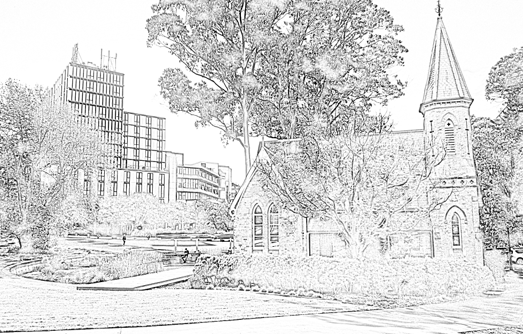
I stare at the reed filled lake, surrounded by a stone retaining wall, that sits at the hollowest point of the green. At its edge is a beautiful old Victorian building with gable facades and a spire. Did the blokes that put together the sun lounges build that too? And why is it here and not on the set of a Harry Potter film where it obviously belongs? The building has church like arches on the windows but I don’t think it’s a church. It looks too substantial, too tethered to the earth for a liminal place. I spot a sign and decide to put my university education to use. It tells me that this is the Old Darlington School House built in the late 1870s. Apparently in the late 19th century, the quiet green space before me was the Darlington town centre with a post office, a town hall, over four hundred houses, almost thirty shops, fifty factories, five pubs, a dance hall and a public school.1 It was one of Sydney’s poorest suburbs which by the late 1940s was labelled a dangerous slum. The university made plans to acquire the suburb but locals, led by activist Freda Brown, protested. They lost the battle and their homes were torn down for what became the Darlington campus which still holds the shadow of the original street patterns within it. The old school is the only building that survived.2

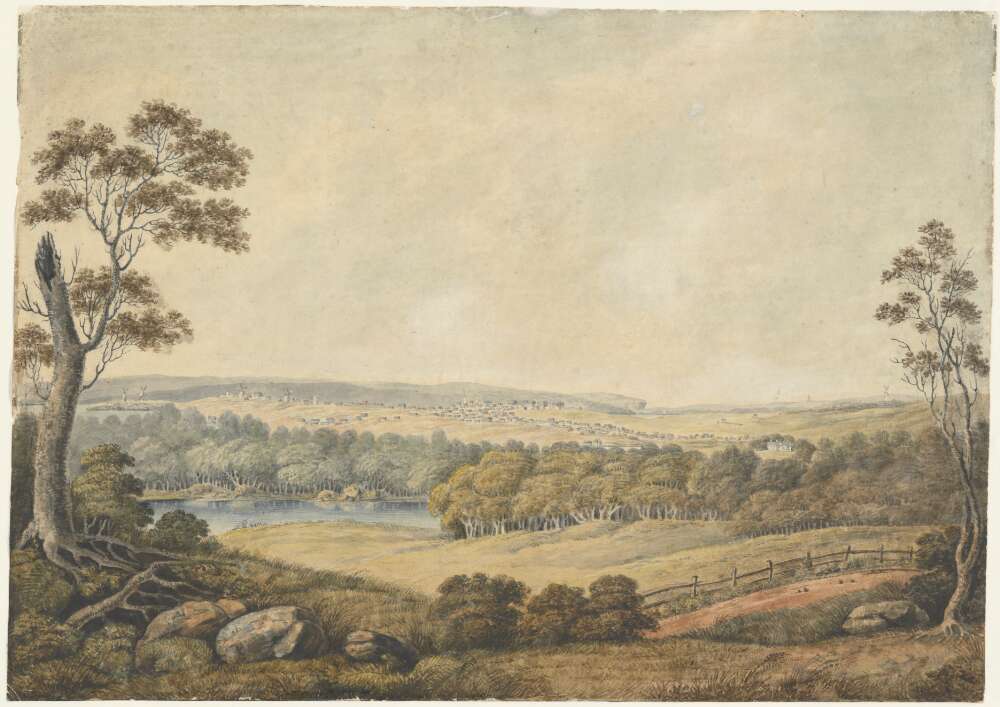
Wow. Now I feel even stranger. Perhaps it was the place I knew as a student that was a mirage. I feel like I’ve never been here before, but the Molecular Bioscience building, the only part of this scene that existed when I was a student here, proves me wrong. I do remember climbing the concrete steps of this Brutalist giant every morning and walking through the Wentworth building and then over the footbridge to the main campus. That same building now creates a border on the southern side of what has been named Cadigal Green. The name harks back to the pre-1788 landscape. Apparently the Indigenous people called it ‘Kanguroo Ground’ before it was unceremoniously taken by Governor Arthur Phillip for the use of churches, schools and grazing animals.3
I feel embarrassed that I didn’t know any of this history at university. I was studying the history of far off places but completely ignorant of the local history of the place I walked in every day. I knew about the rise and fall of Communism across the globe and the 1951 referendum to ban the Australian Communist Party but had no idea that Lawson Street and the suburb of Darlington were once the haunt of some of those very communist activists that had helped to defeat that referendum. I was reading about the civil rights movement in the USA and the freedom rides and 1967 referendum in Australia without connecting any of those events to the Aboriginal people in Redfern, the suburb that I travelled to everyday. And even though I was a fierce feminist, I’d never heard of Freda Brown who throughout her life campaigned for social justice in places like South Africa, then under Apartheid; Afghanistan where she helped women to learn to read; Vietnam during the Vietnam war; and Cuba and Moscow during the Cold War; but also, close to home where she lobbied for equal pay for women and proposed the United Nations International Women’s Year, which was held in 1975 and became the precursor of International Women’s Day.4

Feeling a little lightheaded, I sit down on the edge of one of the sun lounges. Then I lift my feet off the ground and swivel into a lying position, looking at the deep blue sky through the filter of eucalyptus leaves. It’s as if I’ve stepped into a time machine and been whizzed back across the centuries. A place that I thought I knew intimately has been revealed to be a complete stranger. Who knew that time travel could induce travel sickness. Like the naïve everywhere, I’d assumed that what I walked through each day had always been the way I was seeing it. And I also assumed that it would never change. I close my eyes for a few minutes and let the sun warm my face. All those years ago, as I trudged through that old concrete jungle, I could never have imagined that one day I’d be lying here sunbaking. The nausea has receded, replaced by a glimmer of hope. Or is it hunger? It’s time to make my way back to the board walk. It occurs to me that a walk through our memories can re-enchant our world and reinvigorate the digestive system. I feel the distant past merge with all the pasts since, including mine, endlessly recreating the story of this place; rendering the enormity of history down to a human scale.
Back on Abecrombie Street, I realise I’ve thoroughly enjoyed my morning of time travelling. This walk has inspired me to journey back to other places from my past. But first, I step into one of the cafes and order an enormous slice of cake and a coffee.

Footnotes: 1sydney.edu.au/documents/about/heritage/gcp_chapter2.pdf; 2 University of Sydney Grounds Conservation Management Plan, Clive Lucas. majorprojects.planningportal.nsw.gov.au; 3sydney.edu.au/documents/about/heritage/gcp_chapter2.pdf; 4nla.gov.au/nla.party-713097.
Images: Abercrombie Street, Darlington, courtesy of City of Sydney Archives; Old Darlington School and Cadigal Green, writer’s own; Darlington Post Office, courtesy of City of Sydney Archives; ‘West view of Sydney taken from Grose’s farm, New South Wales’ 1819 by Joseph Lycett, courtesy of National Library of Australia; Freda Brown, German Federal Archive via Wikimedia Commons; Coffee and Cake via Wikimedia Commons.


 sage somethymes
Wow! What a lovely read. I remember that walk exactly as you described.
So good! Thank you for reading! I was thinking about you as I wrote it and wondering if you had the same experience. Funny how we never talked about it – probably because we did it everyday and why would you? Have I ever asked about your commute to work? LOL! Dxx
Wonderful. Who would’ve thought that there was so much history along the path many times travelled. It just took several decades in the making 😜😘
Yes!!!! Things often look more interesting in hindsight! LOL! Thanks for reading:)