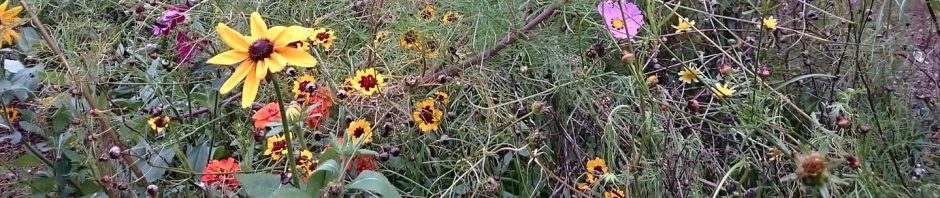
This summer, on returning from my travels where I’d observed so many wild animals in their natural habitats, I discovered a coven of beasts in my own back yard. To be exact, my inner-city balcony. Rather than crying over spilt milk, as they say, or decimated citrus in this case, I decided to turn amateur naturalist (not the nude bathing type) and log the life cycle of these vicious beasts. Or at least my noticing of their life cycle.
Let me begin by establishing the perfect setting before disrupting it with horror. In real estate lingo our balcony has been described as a generous north facing terrace, ideal for al-fresco living. And over time, I’ve developed a distinctive gardening style for this space: a combination of foraged cuttings (unknowingly donated by generous neighbours), rescued containers (discarded by fashion conscious locals) and thoughtful seed gifts (dropped by visiting birds – not from their beaks). I don’t use pesticides or fertiliser. These things cost a fortune and it’s amazing what simple serendipity can achieve instead. It seems my summer lodgers agreed: having no doubt done their due diligence, like any sensible prospective tenants would, before moving in.

On my first day of empirical monitoring, I closely inspected the mini dragon on my dwarf lime. This is the Orchard caterpillar, the early-stage larvae of the Orchard Swallowtail Butterfly. It’s most commonly found in woodland areas across eastern Australia and, as a result of my laissez-faire gardening philosophy, it seems our balcony can now be classified as such. Because I felt an unscientific attachment to my lime tree, I faced a difficult dilemma, do I save the butterfly or do I save the tree? After all, if there is no tree, can there be a butterfly? Or does the butterfly beget the tree? Where does the tree end and the butterfly begin?

I’ve written about my first encounter with the Orchard caterpillar in Lepidoptera where I decided to save the tree. The distressing memory of committing lepidopteracide leaves me only one choice this time – to save the butterfly. So, I decided to watch and wait.
A few days later, the caterpillar began its next instar, as the developmental stage of an arthropod between moults is called. Because nothing much happens while watching a caterpillar, I was augmenting the experience with regular forays onto the internet. I was learning a lot while saving the world’s butterflies, in particular that although so many butterflies are endangered, the Orchard Swallowtail is not. It has successfully adapted to feeding on citrus trees. Whilst pondering whether I should actually be saving the lime tree instead, the caterpillar turned a shade of unripe green but kept its horny scales.
 The next day I discovered that I’d be saving two butterflies – another caterpillar had joined its little friend for dinner. Between them they’d eaten half the lime tree overnight. I watched them for several days as they continued to feed, until the first one was almost the size of the tree itself.
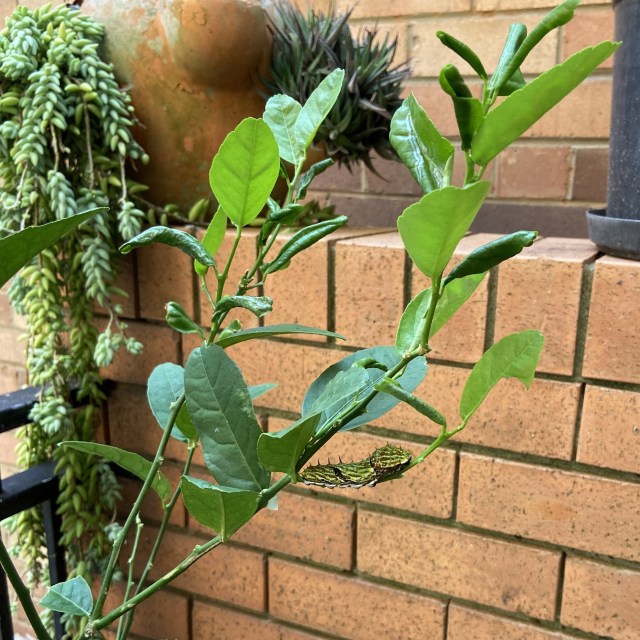
It was shortly after this that it began its metamorphosis from caterpillar to pupa. This experience was not unlike reading a Kafka novel. It began with a journey down the trunk of the lime tree.
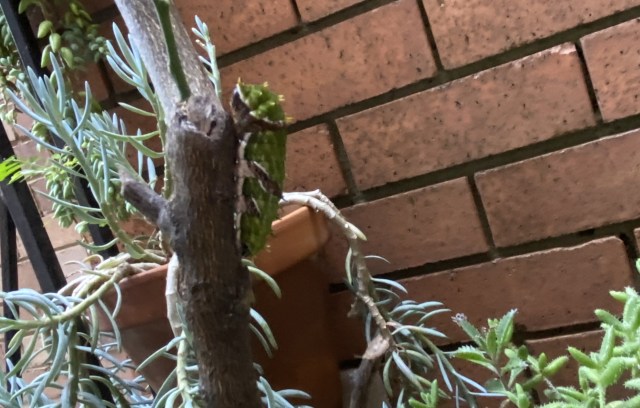
And the next day, while its flatmate was still munching, I discovered it on the slim trunk of the bottle brush next to the lime tree. It had lost almost half of its weight and was conducting a kind of dance with a thin thread that it had emitted from its spinneret; a silk spinning organ much like a spider’s. It was like watching an abseiler rappelling on a rock face. By that evening it had completely encased itself inside a chrysalis. Now this was a skill that I envied.

A few days later, the other caterpillar carried out a slightly less graceful version of the transformation that looked more like it was having a little fit. Alas, when I turned up for morning observation the next day, this caterpillar was nowhere to be seen. Had it been blown away by the wind? Perhaps it had been eaten by a bird? I felt sad that there would now be one less butterfly in the world. And a little guilty that I’d dissed its efforts.

To add to this tragedy, on my next daily patrol I noticed a little hole, about half a millimetre in diameter, in the cocoon of the first caterpillar. On closer inspection, I could see the light shining through the now translucent shell. There was no pupa. And there would be no emerging butterfly winging itself into the world. I didn’t know what had happened, but I suspected the pesky ants I’d noticed zipping up and down the branches had something to do with it.
Turns out I hadn’t saved either butterfly but I consoled myself that at least I had half a lime tree left. And that’s when I noticed, out of the corner of my (do you not gawp in amazement sometimes at just how many things seem to go on at that angle) a very small movement which alerted me to a very large problem. I turned my head, just slightly, and there, on what had once been a lime leaf, was a new monster!
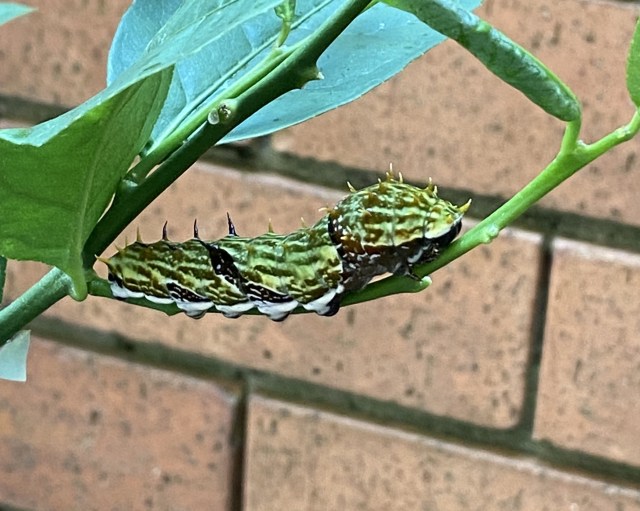
The next day, the tree looked like this!
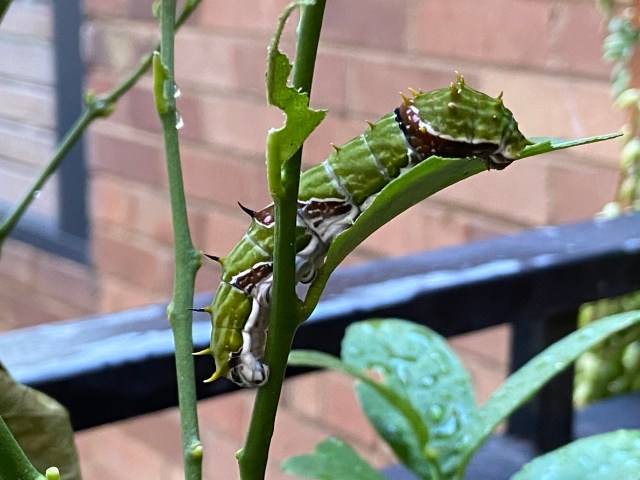
While I’d been logging the life cycle if its siblings, it had been logging my tree! This creature had swallowed the other half of the lime tree and seemed intent on devouring the whole forest. And it was not a gracious guest. It had left a huge mound of small pebbles on the leaf below it, attesting to just how much it had eaten over night!
Even though I can easily identify bird poo, dog poo, cat poo, cockroach poo, kangaroo poo, wombat poo, lizard poo and human poo (with all its arbiters of digestive issues), I have never seen giant caterpillar poo.

I was faced once again with the moral question: do I save what’s left of the tree or wait in hope that this time a butterfly would emerge? I decided to procrastinate instead and do a little scatalogical research about this creature. Fortunately, I was saved from making a decision because by the time I returned to my observation post, the caterpillar had travelled the length of the tree, crossed a land branch and migrated to the nearby bottle brush tree where it had attached itself, like a small green sickle moon, to the trunk.

Forty-eight hours later, it had spun itself into a green tinted chrysalis carefully camouflaging with the branch so that only a sharp-eyed citizen naturalist would be able to spot it.
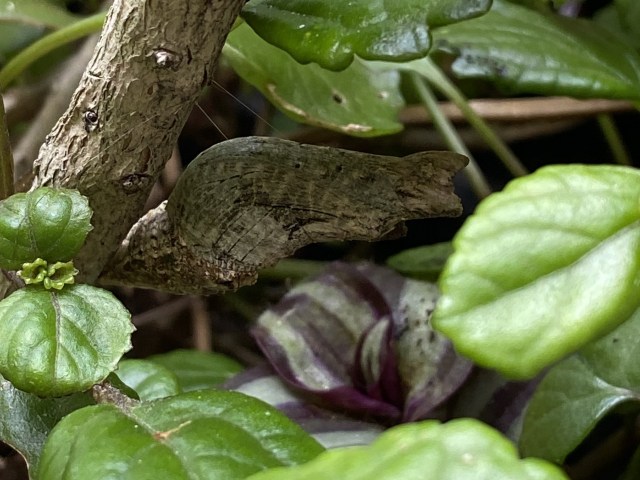
Where does the tree end and the butterfly begin?
I’ll meditate on this ontological question over the next few weeks, as inside the chrysalis the caterpillar dissolves its former self and transforms into a butterfly, emerging for only the length of a season to make our world its garden home.


 sage somethymes
Love it. I think in every instance allowing nature to do its thing is best. Both tree and butterfly have an amazing resilience to support each other. 🤷🏻♀️
Thank you for reading! And totally agree!
The coven of beasts and monsters are apt descriptions, and indeed will be the thing of nightmares.
Indeed! And they are just outside at night as we sleep – waiting quietly to become new beasts! Thanks for reading:)