I’ve been trekking through Waterloo and Redfern hunting for lost churches. Two of them. To paraphrase Oscar Wilde, “To lose one church may be regarded as misfortune; to lose both looks like carelessness.” Luckily, I think I’ve found them. Or at least where they used to be. (But beware, family photos have been used in this post and they include loved ones that have passed on.)
Although I’m not devout, I think churches are fascinating archives of time and place. And I do love to find an open church and sit for an empty moment. It feels like an escape from the binds of time. As urban moderns, it’s tempting to throw out the baby of spirituality with the bathwater of religion but I’ve decided to keep what I like and let the rest go. I guess my early church experience, in particular receiving the sacrament of baptism, turned me into a non-practicing cafeteria Catholic.

But back to looking for lost churches. As I stood on the corner of Redfern Street and Walker Streets, the former site of the first Antiochian Church in Sydney built by Syrian and Lebanese Orthodox Christian migrants in 1920, I witnessed a strange encounter.
A man pushing a shopping trolley along the road came to a stop at the intersection. He paused to check for traffic. Balanced precariously on the top of the trolley was an old two-seater couch in an unusual shade of green velvet, possibly absinthe. Although Redfern is the kind of place where you will often see strange items transported on bicycles or trolleys, I’ve never seen such a large or colourful piece of household furniture moved in this way. To properly quote Oscar Wilde, “I can believe anything, provided it is incredible.”
The man craned his neck around the side of the couch to see if it was safe to cross. That’s when I heard him say to himself, “Oh, here we go.” Looking in the same direction as he was, I saw two mounted police officers, walking their chocolate brown horses slowly up the hill to where we were standing.
The expression on the man’s face brought to mind Jesus in the garden of Gethsemane. As the officers passed us, one of them called out, “How ya doing?” like they knew the man and often crossed paths like this. Perhaps they did. He tipped his hat to them, literally, he was wearing an old dark green baseball cap. As her horse paced steadily past me, the policewoman looked down and smiled. I felt like a character in a bucolic 19th century novel. As the horses continued their slow clip clop down the other side of the hill, the man crossed the road with his load and continued on his way. The lesson for me: I don’t actually need to be sitting in a church to experience the mysteries of the universe.
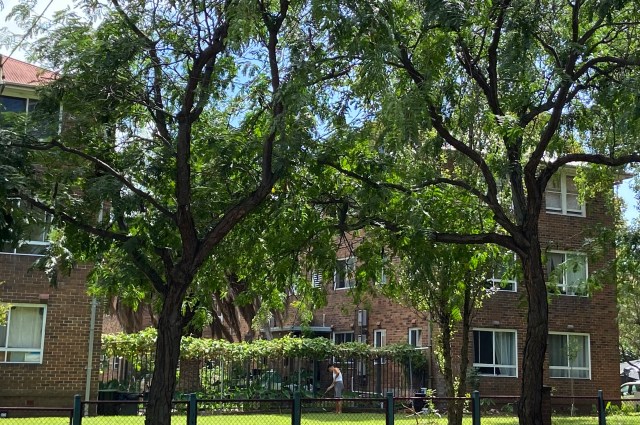
So I turned back to the simpler contemplation of changes in the landscape. The archives are silent on what the church that used to stand on this corner looked like. I did discover that it was built on land leased from the NSW Government. In 1950 the lease ended and the church was demolished, replaced by three-storey red brick public housing flats. In 1953 the community built a new church – the St George Antiochian Orthodox Cathedral – about a hundred metres away on the corner of Cooper and Walker Streets.

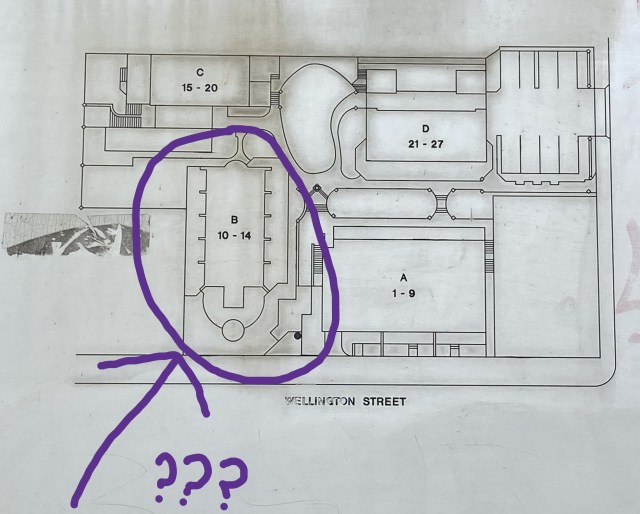
The other lost church is St Michael the Archangel Melkite Church which used to stand on Wellington Street in nearby Waterloo. Walking past previously, I’d noticed the 1970s housing estate block whose entrance distinctly mimics, in brick, the sandstone arched doorway of a gothic style church. Next to it is a graffitied wall in faded salmon with a map of what looks like the floor plan of an early Christian Basilica.
But walking past this morning, I noticed that the salmon camouflaged an arched entrance, now blocked off but still sign posted by Boston ferns and other wild greenery that grow from the line of plaster that outlines the old arch. Above this, the top of the wall mimics the ramparts of a castle and behind it is a faded pink and baby blue turret, with its own arches. From across the street, you can clearly see the classic pitched roof and Saxon style tower. The plot had suddenly thickened. Could this old wall be hiding a secret church?
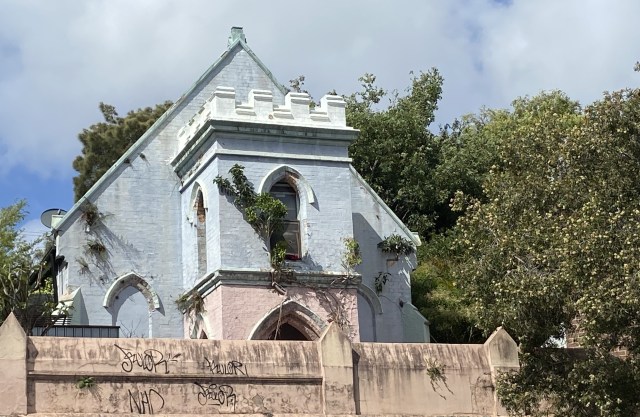
So, I detoured into the nearby library ready to do some good old detective work on the history of Waterloo. Unsurprisingly, I read that the suburb’s heyday was over a century ago. Then, thanks to an article by Jack Bettar for the Australian Lebanese Historical Society, and the friendly librarian, I discovered that there had indeed been a church behind the mysterious wall. It was built by migrants from Syria, Lebanon, Egypt and Sudan circa 1895 but the site was sold to the NSW Housing Commission in the late 1970s. The congregation moved to nearby Darlington and the church was replaced by housing estate flats. There was definitely a demographic pattern happening here. But there was also more unsolved mystery. The image of the church that I’d found in the library was very similar but also very different to the remains of the site now.

I was determined to solve this conundrum and after careful examination of dates, I realised that there was a plausible explanation for this archaeological discrepancey. The older photo was taken in 1939 and reflects renovations that were made to the church site in the early 20th century. Now I felt like a proper sleuth.
It was as I read more about the history of Lebanese migrants in Sydney that I discovered the other vanished church in my neighbourhood. Determined to find it, I’d made my way to the intersection where I witnessed the encounter between the police and the absinthe couch man, as I’ve decided to call him.
These lost churches should not have taken me by surprise because my local area is thick with places of worship. These include the Annunciation of our Lady, Greek Orthodox Cathedral; St Maroun’s Maronite Cathedral; four Catholic churches – St Vincent de Paul, Our Lady of Mt Carmel, St Peter’s and St Benedict’s; the Indonesian Christian Church, GKY Sydney; the Sydney Maori Arohanui Fellowship of Te Wairua Tapu; the Hill Song Church and One1Seven Church. There are also the Redfern Mosque, the Quaker Religious Society of Friends Meeting Place, and the NSW Evergreen Taoist Church.

Interestingly, most of these places are located in the hills of east Redfern. This shouldn’t surprise me either because historically churches were often built on higher ground and in Sydney they were some of the earliest land grants to be made. In the 19th century, Surry Hills and Redfern had a large Irish Catholic community and a larger protestant population. The churches in this neighbourhood map the waves of immigration that have flowed through the city after the tragic dispersal of the original inhabitants. New migrant communities often took over the buildings of churches no longer used by earlier denominations who had moved on from the area. These places hark back to a time when religion was not only a main marker of identity but an important social connector in a new land.
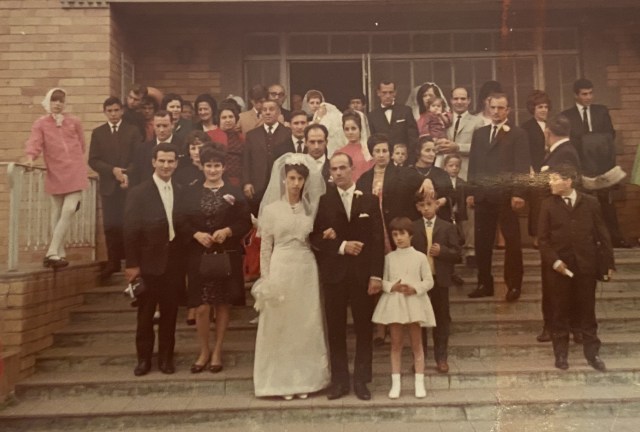
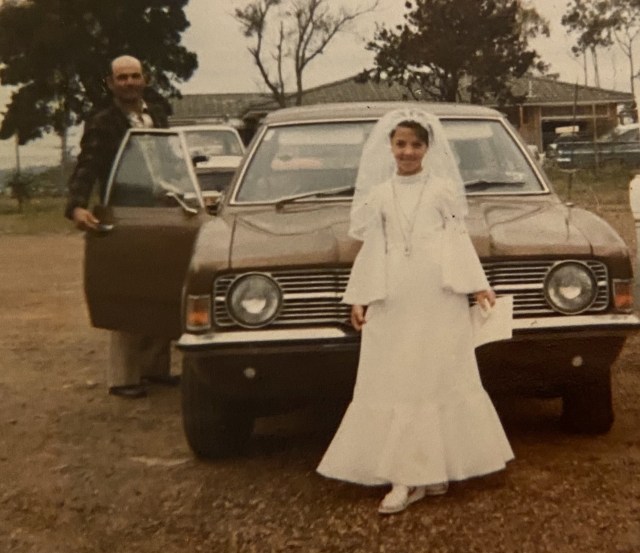
Let me segway for a moment into some personal history to evidence this point. My parents were Italian migrants and although neither of them were overtly religious, they married and christened their children in a church in Johannesburg. They also turned up for weekly mass. But I suspect it was Sunday lunch with all the other ex-pats, following the service, that drew them back regularly. After arriving in Australia, my family’s attendance at church was reserved for special occassions: Easter, Christmas, weddings, funerals. Most weeks, Sunday church services were replaced with Sunday lunch at the Italian club. And so, as a teenager, after completing the ritual of First Holy Communion, I was left free to roam in the garden of spirituality and occasionally out onto the footpath of agnosticism, with the rare foray onto the wide road of atheism.
After the morning’s exertions I was happy to leave the past and its churches behind and decided to pop into one of my favourite coffee shops, the aptly named St Jude’s. But first I had to find it. It’s one of those places that has a mysterious habit of disappearing – it never seems to be on the street I think it’s on and so I’ll walk around and around in ever narrowing street blocks, getting hotter and hotter, and hungrier and hungrier, as I try to locate it. I tell you; it’s easier to find a lost church than it is to find a vanishing cafe. But, glass half full and all that, it’s always great exercise and when I finally did stumble upon it, I indulged, guilt free, in one of their delicious freshly baked muffins.

The cafe is on Bourke Street, just a few doors down from the home of the chocolate coloured horses, so as I sipped my coffee, I thought back to the man with the absinthe couch, and wondered what Oscar Wilde would have had to say. Perhaps: “to encounter one chocolate coloured police horse may be regarded as misfortune; to encounter two looks like carelessness.”


 sage somethymes
I loved this! It’s opened a window of knowledge I didn’t have. So many churches! Wow. The visual of the old man carting his couch while stopped at the traffic lights whilst policemen on horseback rode past and politely acknowledging him felt like a scene from the 17th century. Brilliantly written D! Lovely photos too. Ahhh, the memories 😘
Oh thank you! It was great fun to write and such a weird encounter with absinthe couch man – I do love those horses and the fact they wander our streets! And I believe you make a guest appearance in one of the photos 😉