Recently I discovered a secret source of wild berries. Or they discovered me. I was walking innocently along a footpath while on a lunch break when my shoes became stuck in a patch of violet slime. After using the edge of the gutter to scrape off as much as I could, I looked up into the high branches of the tree above me. It was laden with heavy purple fruit that looked like giant blueberries; in the same way that Diprotodons look like enormous pre-historic wombats. The slime of course was the purple wombats turned to jam; squashed by the stomping feet of passers by. This of course appealed to my Italian wine making genes.
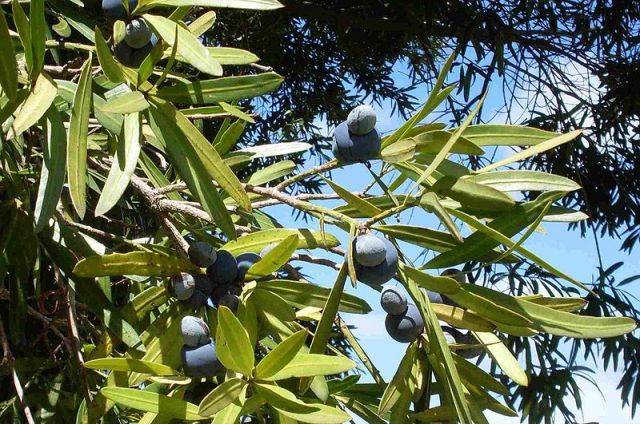
But although I love the tradition of homemade Italian wine I don’t like drinking it. I much prefer my wine to be made by modern viticulturists in high tech wineries with premium grapes. But I have none of these qualms when it comes to blueberries. I love blueberries; no matter who has grown or harvested them they always taste like a tart little piece of blue heaven. I love them in muffins, on yogurt but mainly just eaten by the punnet all by themselves. And just like a top quality wine they’re terribly expensive. So you can imagine how excited I felt to be looking into a tree full of them.
In the flash of a wonder woman twirl, albeit without the phone booth, I dropped my disguise as a city office worker and transformed into an urban food forager. Oblivious to the concerned glances of passers by, I swung my legs over the chain link fence that separated the footpath from the tiny bit of green that the tree stood on. On hands and knees I gathered several uncrushed specimens of these enormous blueberries, placing them carefully into my empty lunch box. I then took samples of the leaves from the tree; they too went into the lunch box.
Now, you’re probably wondering why I didn’t just gorge myself on all this free fruit there and then. Rule number one of foraging is don’t eat anything that you are not absolutely sure of. So although I had foraged before, it had always been in domestic environments that I could trust. Most recently lemons from a friend’s back yard tree, but also basil, figs and tomatoes from my mother’s garden (and cheese and prosciutto from her fridge). I realized that I’d never actually harvested a genuine wild source, admittedly in disguise as a street tree planted by the local council. So I thought it best to listen to the over cautious part of my brain that doesn’t like to swallow anything that could kill me.
And so with all the enthusiasm of the amateur naturalist I spent hours trawling the internet in an attempt to identify my specimens. And that’s how I finally discovered that, although they weren’t actually giant blueberries (or purple wombats for that matter), they were indeed edible and in fact one of the more coveted native Australian bush foods, at least south of the border. Apparently they don’t think much of them up in Queensland. But let’s face it, with the impending Adani coal mine about to be constructed in that state, it seems Queenslanders don’t think much of the Great Barrier Reef either.
My research told me that I was in possession of a tasty crop of Illawarra plums or Podocarpus elatus, which is pretty much how I felt when I found that my foraging instincts had been spot on.
I also learnt that May or Autumn is the D’harawal season called Marrai-gang, a time when “the spotted tail or tiger quoll… can be heard growling and screeching in the night on the lookout for a mate. The lilli pilli is berrying and the magenta, crunchy, miniature-apple-like fruits are a favourite for birds, animals and members of the clan. … if you’re scraping hardened, purple bat and bird Lilli Pilli poo off your car, the Time of the Marrai-gang has well and truly settled in.”1
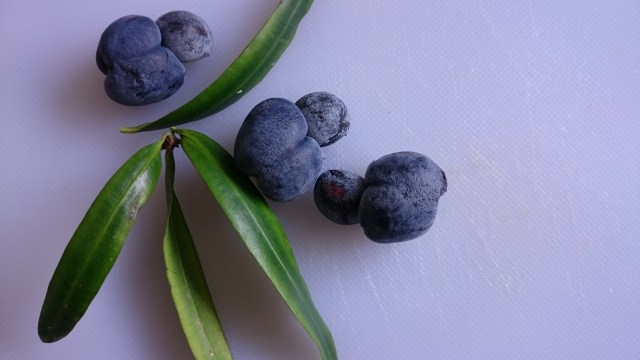
I highly recommend this website. It was a fascinating read. So although my specimen wasn’t a scarlet Lilli Pilli berry it was exhibiting the same sticky characteristics and inspired me to continue my online research.
Then I struck gold, according to the Australian National University, the Illawarra Plum produces a fruit that “is rich in taste, with subtle pine and mild resinous flavours apparently enhanced with cooking.” Notwithstanding that the webpage had a warning that the site was no longer maintained by anybody at ANU, it went on to say that, “In NSW, Illawarra plums were regarded as one of the best wild foods by Aborigines and early settlers. They are …commonly served today as a sauce in wild food restaurants.”2
Well that was plenty of provenance for me.
Now some people see food foraging as a political activity; the gathering of free food available in urban environments as an act of rebellion against the industrial food system. For others it’s a spiritual fascination; the ability to connect with the natural world on a city street. But there is also the thrill of the treasure hunt; and for me the link to my peasant forbears who roamed the arid hills of Sicily foraging for wild greens. But by far the greatest incentive is budgetary. At upwards of $5.00 a punnet, berries are ridiculously expensive, so finding a free version, in abundance, is an occasion for celebration.
I had found them. But now they must be harvested. The big question was how.
Climbing the tree was a possibility. I would need a longer lunch break, and a ladder. I’d also need the right clothing. A horticulturalist’s outfit – and by that I don’t mean a pretty floral dress. I would have to wear a long sleeved drill shirt and gardening pants with tool pockets, all in a lovely shade of camouflage, after all, I wanted to keep my city harvest a secret. Ironically I’d also have to wear a fluorescent tradies vest so that no questions would be asked about my right to climb the tree. My harvest after all was located in a high security, civic precinct. I wouldn’t want a security guard to mistake my purpose, which albeit not innocent, was far from evil. I’m simply an upstanding citizen who can’t stand seeing good food go to waste.
But that brought me to the second question. Would the fruit be worth all the effort it would take to harvest? Although I had gathered, photographed, and catalogued my wild find, I hadn’t actually tasted it. It would be a complete waste of an extended lunch break to die from mysterious food poisoning. The sensible thing to do would be to taste test the original sample. But unfortunately that overly cautious part of my brain simply put its foot down and refused to let me do that. It’s times like these that I regret not being a member of a powerful ancient royal household complete with my own personal food taster.
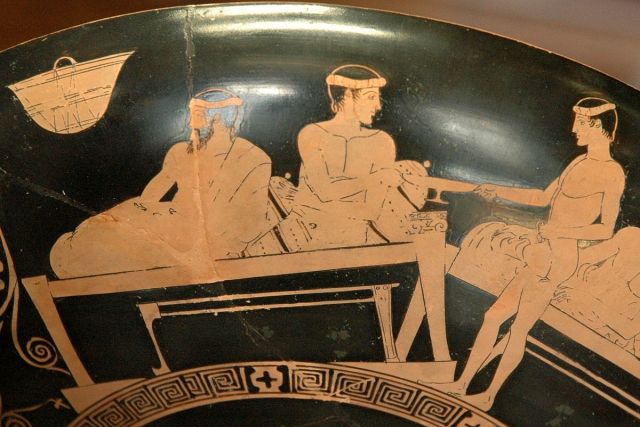
In the absence of that I decided to enroll my family and friends in the experiment. Surprisingly I faced a distinct lack of enthusiasm. It seems that the average suburbanite is afraid of putting anything into their mouths that hasn’t been bought at a supermarket.
And so once again the spirit of science is sacrificed by a lack of courage and I am doomed to watch a season of wild plums go to waste. And at the supermarket I’ll be forced to hand over a fistful of cash in exchange for a puny punnet of common variety farmed blueberries. But I will eat them with hope because I did extract the seeds from my samples and I buried them in a pot full of soil on my terrace. Perhaps by the time the seeds have grown into a tree there might be a new generation of braver souls ready to taste the purple wombats.
(1) http://sydney.edu.au/news/science/397.html?newsstoryid=15064
(2) http://fennerschool-associated.anu.edu.au/fpt/nwfp/iplum/Iplum.html#anchor281213
Images 1 and 3 in the public domain, courtesy of Peter Woodard and Euaion Painter. Image 2, authors own.






 Rebecca Solnit embodies two of my favourite attributes, she writes exquisitely and is a radical peddler of hope. Described as a ‘cultural historian in the desert mystic mode’, Solnit argues that our pessimism and despair arise from assuming we know what will happen next. Subtitled Untold Histories, Wild Possibilities, this fascinating collection of essays unearths the transformative power of political engagement.
 Ok so it’s obvious I’m a big Solnit fan but she just writes so beautifully. This is a book about walking. It’s also a history of thinking while wandering, with tales and adventures of the mind and spirit from philosophers and poets, trouble makers and adventurers. I also recommend The Faraway Nearby, A Field Guide to Getting Lost and The Encyclopedia of Trouble and Spaciousness.
 Part self help, part cognitive psychology this entertaining and wise book inspires us to use classical philosophy to solve modern day problems. Structured as a day shadowing the ancient philosophers at the School of Athens it will inspire you to keep your New Year resolutions.
 This is a fascinating survey of the native foods that grow on our continent and have been used for thousands of years by Indigenous Australians. I love the suggestion that we celebrate Australia Day with a meal of native Australian foods shared between European and Aboriginal Australians. A revolutionary idea and a perfect way to commemorate the 50th anniversary of the 1967 referendum this year.
 A delight to read, this beautifully written book delves into all aspects of the elusive quality of grace. Subtitled, On Moving Well Through Life it’s like a wander through a well curated modern art museum. It ends with a lovely chapter guaranteed to make even the most slothful and clumsy amongst us more at ease in the world.
 A delicate love story immersed in the philosophy and high art of Chinese cuisine. Sublimely written it is nourishment for the soul but it will also make you hungry for the traditional food of the Middle Kingdom. (Try Chinatown’s Golden Century where Sydney’s top chefs can be found after their shifts). I also enjoyed Mones’ other novels set in modern China, Lost in Translation and A Cup of Light.
 This is a terrific memoir of a life well lived. Gloria Steinem regales us with tales from her travels. As a feminist activist, democratic organiser and writer since the 1960’s, she credits a deeply held attitude of hope to a lifetime on the road.
 I love this writer and this, her latest novel, is possibly also my favourite. Set in a small American town that is about to be drowned to make way for a dam, it is a beautiful exploration by the main character, Mimi Miller, of truth, identity and home. Quindlen is just one of several female American writers whose novels I have enjoyed. Others include Barbara Kingsolver, Anne Patchett, Amy Tan, Ursula Le Guinn, Toni Morrison, Nicole Mones and Marilyn Robinson.










 sage somethymes